Showing posts with label Thomas Wentworth Higginson. Show all posts

Tuesday, October 27, 2015

Grand Review In Harrisburg - Great Way To Cap The Sequicentennial

I thought I was done with Civil War Sesquicentennial events after the Grand Review in May.  It turns out that there is one more event, I just have to attend.  Another Grand Review - this one in Harrisburg.  The original Grand Review (although not its Sesquicentennial) had excluded black troops.  In November, though, there was a Grand Review for the United States Colored Troops and that will be commemorated on November 13th and 14th in Harrisburg Pennsylvania.

A Bit Of Historiography

The contribution of black soldiers and sailors to Union victory was one of those things that got thrown in the historiographical memory hole for a couple of generations.  It started creeping its way back into general consciousness in the nineteen sixties, when people started talking about Black History.

I have this fairly elaborate theory that I have been working on about views of American history.  A short version is that the culture of the United States America, the elements that explains why we are not European was well formed by the time Alexis de Tocqueville visited in the eighteen thirties.  Among the constituent elements are four pretty distinct groups from the British Isles, the indigenous peoples, people taken in captivity from Africa and a melange of German and Dutch in the middle colonies.  They baked the cake.  The wretched refuse yearning to breathe free started flooding in sometime after that and provided the icing and the cherry on top.

My theory is that a unified American history was really for the benefit of the wretched refuse.  Anybody who identified with one of the elements would have their own distinct narrative.  (A complication is that the identification with any of the elements does not necessarily imply ancestry.

 Jim Webb, the most badass of the participants in the most recent Democratic debate, in his Born Fighting: How the Scots-Irish Shaped America makes a strong case that much of the culture of the American military and white working class derives from the Scots-Irish, who came to America in the first half of the eighteenth century indirectly from the Scottish border region by way of Ulster.  They did not linger on the coast but sent straight to the frontier.  Think Daniel Boone, Davy Crockett, Andrew Jackson and about 95% of the Confederate Army.

The ironic thing is that that group probably has the most in common with African Americans of any, which is why they love one another so much or not.

At any rate Civil War historiography for the masses- post 1840 immigrants, their children, grandchildren etc was heavily influenced by a romanticized version of the Confederate cause and the notion, somewhat accurate, that white northerners, mostly, did not care that much one way or the other about slavery.  Paul Buck explained the process in his Pulitzer Prize winning Road To Reunion in 1937.
The memories of the past were woven in a web of national sentiment which selected from by- gone feuds those deeds of mutual valor which permitted pride in present achievement and future promise. The remarkable changes that had taken place within the short span of a single generation had created a national solidarity hitherto unknown in American life. The reunited nation was a fact.
The 180,000 black soldiers in the Union Army were an inconvenient fact in this narrative, so they slipped from popular memory.  In the segregated schools of the South, they were remembered though. And they resurfaced as part of "black history" or as we might more accurately say "history" beginning in the sixties.

One of the things that made them easy for them to be forgotten was that they came in heavily after the big exciting battles like Manassas, Antietam, Chancellorsville and Gettysburg.

Black Reenacting

It is too bad I am such a lousy reporter, so I only have bits and pieces to support this.  As far as I have been able to tell Civil War reenacting got going seriously in the run-up to the Centennial which went real light on the issue of slavery.  It was a pretty white affair until the movie Glory in 1989


Most of the black reenactors I spoke with at different events either started after the movie Glory or were in the movie Glory.

Better Than Banning The Confederate Flag

You can't cut the romantic version, somewhat accurate, of the Confederacy -brave men defending their homeland from invasion - out of the American psyche,  Our country has the only world class military academy - West Point - that fought a heck of an intramural war before being called to rescue the world from totalitarianism.  It gave us a tradition of being magnanimous in victory, if not quite gracious in defeat.

But we cannot forget that the Civil War was a war for liberation by a significant number of the people who fought in it.  So rather than tearing down monuments to the Confederates, let's be putting up monuments to the USCT soldiers who faced them.


Note

For Civil War nerds - As far as I can tell the Masschuessetts black regiments were never incorporated into the United States Colored Troops unlike Colonel Thomas Wentworth Higginson's First South Carolina Volunteers which became the 33rd USCT.


Sunday, June 29, 2014

Gettysburg Interlude - Understanding Historiography

This was originally published on forbes.com on July 5, 2013 as part as my Gettysburg Sesquicentennial coverage.  For the anniversary of the anniversary, I am putting this first.  The rest of the Gettysburg posts will be as close to real time as possible.  There will also be many more pictures than I put up on forbes.com
________________________________________________________________________________

Civil War enthusiasts.  Civil War buffs. Civil War nuts.  Call them what you want.  Despite my covivant's conviction to the contrary, I will not cop to being one of them.  The main evidence in my favor is that I embraced the Margaret Fuller bicentennial with much more enthusiasm than the Civil War sesquicentennial.  Gather 1,000 Civil War buffs in a room and I doubt you will find 20 who know who Margaret Fuller was.  When she died in 1850, she was the most famous woman in the United States of America.

Margaret Who ?

Born in 1810, Margaret Fuller inspired a generation of younger activists.  Among them was Thomas Wentworth Higginson one of the "Secret Six" who backed John Brown's raid on Harper's Ferry. Included in the  grievances that are listed in the Declaration of the Immediate Causes Which Induce and Justify the Secession of South Carolina from the Federal Union are these acts of the Northern states:
Those States have assume the right of deciding upon the propriety of our domestic institutions; and have denied the rights of property established in fifteen of the States and recognized by the Constitution; they have denounced as sinful the institution of slavery; they have permitted open establishment among them of societies, whose avowed object is to disturb the peace and to eloign the property of the citizens of other States. They have encouraged and assisted thousands of our slaves to leave their homes; and those who remain, have been incited by emissaries, books and pictures to servile insurrection.
So why don't Civil War buffs know who Margaret Fuller is ?  Or even Thomas Wentworth Higginson who would command a regiment and whose memoir, Army Life In A Black Regiment, is considered by some one of the best civil war memoirs.  In order to answer that question you have to think about historiography.

What is Historiography ?

According to the infallible source:
Historiography refers either to the study of the methodology and development of "history" (as a discipline), or to a body of historical work on a specialized topic. Scholars discuss historiography topically – such as the "historiography of Catholicism", the "historiography of early Islam", or the "historiography of China" – as well as specific approaches and genres, such as political history and social history. Beginning in the nineteenth century, with the ascent of academic history, a corpus of historiographic literature developed.
In order to understand what the Civil War means to people now and how it came to mean that, you have to study historiography.

Idiot's Guide To Civil War Historiography

To say that you can boil Civil War historiography into two schools might seem absurd, but I think a reasonable case can be made.  Among enthusiasts, on either side, the two schools are the right one and the wrong one or the things that "they" want you to believe and the truth.  As somebody once told me, my problem is that I am an Aquarian and want everyone to get along.  So I will refer to the two schools as Lost Cause and Neo-abolitionist.  Fortunately, I did not make either of those terms up so I can go to the infallible source for definitions.

Lost Cause
The Lost Cause is the name commonly given to an American literary and intellectual movement that sought to reconcile the traditional white society of the U.S. South to the defeat of the Confederate States of America in the American Civil War of 1861–1865.Those who contributed to the movement tended to portray the Confederacy's cause as noble and most of its leaders as exemplars of old-fashioned chivalry, defeated by the Union armies through overwhelming force rather than martial skill. Proponents of the Lost Cause movement also condemned the Reconstruction that followed the Civil War, claiming that it had been a deliberate attempt by Northern politicians and speculators to destroy the traditional Southern way of life.
Neo-Abolitionist
Neoabolitionist (or neo-abolitionist or new abolitionism) is a term coined by historians to refer to the heightened activity of the civil rights movement in the late 1950s and early 1960s. The term was soon used by leading historians to refer to the moral impulses of historians influenced by the Civil Rights movement in their studies of slavery, Reconstruction, segregation and Jim Crow. Bradley (2009) says, "Inspired by the civil rights movement, neo-abolitionist historians such as John Hope Franklin, Kenneth M. Stampp, and Eric Foner took their cue from DuBois and placed blacks front and center in their Reconstruction narratives." They led a re-evaluation of Reconstruction and its aftermath that focused on the significance of full citizenship and suffrage for African Americans. Thus Allen C. Guelzo (2009) refers to "the most recent neo-abolitionist histories from Henry Mayer and Paul Goodman" as well as "older neo-abolitionists like James McPherson, Howard Zinn, and Martin Duberman.".George M.Fredrickson (2009) says, "Neo-abolitionist historians profess to derive their standard from the abolitionists of Lincoln's own time."
Who Is Right ?

You have to be kidding to ask that question. Lost Cause believers and Neo-abolitionists ask different questions of different sources.  They can both tell true stories that are deep and rich and inspiring.  Lost Cause has one very serious weakness. In order to continue to believe wholeheartedly in the full Lost Cause narrative, you have to avoid reading material that is written in the South before 1862.  If you are a Lost Cause enthusiast, I would never try to talk you out of it.  I would ask that you read just one thing -  Declaration of the Immediate Causes Which Induce and Justify the Secession of South Carolina from the Federal Union.  Read it a couple of times and then explain it to me.  The only theory that I have been able to come up with is that it was really all about tariffs, but they were embarrassed about that, so they just said it was about slavery.

Why Did They Fight ?

When people start arguing about this they usually do it by setting up straw men that are relatively easy to knock over.  Nobody has ever seriously maintained that Northern soldiers were incipient NAACP supporters.  There were probably not that many officers who would give speeches where they said they were an army fighting to make other men free.


You will, however, find Lost Cause enthusiasts "proving" that they are right by showing how racist Northern soldiers were.  My own reading leans me towards concluding that a large portion of the Southern elite was very pro-slavery.  A very small portion of the Northern elite were militant abolitionists.  Regular folks - there is a lot of controversy and a lot of problems with the evidence.  The debates can make you a little crazy.  Maybe most Southern soldiers did not come from slave-holding families - depending on how broadly you define family.  On the other hand, if you are twenty years old and don't own a car or a house, it does not mean that you would not like to own one.  Clearly, though, to the extent there was an idealistic motivation for most regular folks, it was that bad guys were trying to take their country away.  Some of them thought they lived in a bigger country than others.
Why Can't We All Just Get Along ?
The Lost Cause had a pretty good historiographical run.  It served the interest of white people in both the North and the South.  And it is not as if you cannot find a lot to support it.  Lost Cause people may have buffed up the image of Robert E. Lee a bit, but they had really great material to work with.  Paul H. Buck explained the process in his Pulitzer Prize winning Road to Reunion in 1937.
The memories of the past were woven in a web of national sentiment which selected from by- gone feuds those deeds of mutual valor which permitted pride in present achievement and future promise. The remarkable changes that had taken place within the short span of a single generation had created a national solidarity hitherto unknown in American life. The reunited nation was a fact.
Lost Cause was not a purely Southern invention.  Even a governor of a Northern State, a Medal of Honor winner, wounded six times and promoted to Major General had a hand in it. Joshua Chamberlain wrote:
I was told, furthermore, that General Grant had appointed me to take charge of this parade and to receive the formal surrender of the guns and flags. Pursuant to these orders, I drew up my brigade at the courthouse along the highway leading to Lynchburg. This was very early on the morning of the 12th of April. ......

At such a time and under such conditions I thought it eminently fitting to show some token of our feeling, and I therefore instructed my subordinate officers to come to the position of 'salute' in the manual of arms as each body of the Confederates passed before us. .......
The General [Gordon] was riding in advance of his troops, his chin drooped to his breast, downhearted and dejected in appearance almost beyond description. At the sound of that machine like snap of arms, however, General Gordon started, caught in a moment its significance, and instantly assumed the finest attitude of a soldier. He wheeled his horse facing me, touching him gently with the spur, so that the animal slightly reared, and as he wheeled, horse and rider made one motion, the horse's head swung down with a graceful bow, and General Gordon dropped his swordpoint to his toe in salutation.
Around the same time that Road to Reunion was published Lost Cause entrenched itself firmly in popular culture.


For the last fifty years neo-abolitionism has been gaining ground.  It won the colleges early.  If you win the colleges, within a generation you have the high schools and the elementary school. The centennial was all Lost Cause all the time, but the sesquicentennial is heavily neo-abolitionist.  As you walk into the museum at the visitor center you see a sign that says in part:
Americans fought one another over three fundamental issues: the survival of the union, the fate of slavery, the common rights of citizenship - what it means to be an American -the war resolved the first two issues.  The nation struggles with the third to this day.
Now that is neo-abolitionist with a vengeance.

How Do We Get Along ?

We get along by practicing a form of apartheid.  The educational system is neo-abolitionist.  Popular culture remains Lost Cause to a significant extent.  The educational system does not pay very much attention to the actual war.  Civil War buffs do not pay very much attention to what happened other than things relating to the actual conduct of the war.  When I was a history major, one of the professors told me they did not offer a course specifically on the war itself, because when professors  did that they always ended up with a couple of pain-in-the-ass nineteen year old buffs who knew more than they did.  I'm sure that has evolved some, but when I was at the Pickett's charge event, a high school history teacher from South Carolina was grumbling about the curriculum not having anything about actual battles.

How Does It Work At Gettysburg ?

Gettysburg is ground zero for both interpretations.  I think what the organizers for the Sunday night televised event did was invite Doris Kearns Goodwin to the wrong party.  Her speech aggravated some people by being too much about Doris Kearns Goodwin.  It outraged other because of its reference to the DOMA decision.  When Doris Kearns Goodwin said "Stonewall", she was not talking about how the battle might have turned out had General Jackson not encountered friendly fire at Chancellorsville.  If Doris Kearns Goodwin had given the same speech four and a half months from now and a few hundred yards to the east, only the self-absorption would have been aggravating.  The high water mark and July 3 will forever belong to the Lost Cause and nobody should try to disturb that. Neo-abolitionists have a very strong claim on the Gettysburg address where it was reconfirmed that we are dedicated to the proposition that all are created equal.

My next post will be about the July 3 experience, which, like the Centennial, was all Lost Cause all the time.

You can follow me on twitter @peterreillycpa.

 Afternote

 Like many people I think of the rise of Neo-Abolitionist views as beginning around the 1960s.  Lost Cause enthusiasts will still refer to them as "revisionist".  A recent book I read The Southern Past - A Clash Of Race And Memory by W. Fitzhugh Brundage gave me a bit of a different perspective.  We will often think of Lost Cause as the Southern version, but that would be while accurate, perhaps imprecise.  Lost Cause is the white Southern version.  Black Southerners in their segregated schools learned a history that was more celebratory of emancipation.


Day 0 Pickett's charge reenactment not on the battlefield.


Friday, May 23, 2014

419 Reasons to Like Nigeria and Nigerians - Part 3- Cherish Your Diaspora

You'll have to go back into the previous posts if you want the connection that this has to taxes fully explained.  It is a tax court decision from 1952 that sent me down this path. This is the final post in this series, unless I decide to do more.  Earlier in the series I proposed that people start making lists of 419 reasons to like Nigeria and Nigerians.  

Why 419 ? Well if you don't know you're not going to find out in this post.  As I noted in my last post, I don't know that I have anything worthwhile to offer beyond the original idea, assuming for the sake of argument that the original idea was worthwhile.   Regardless, I observed that there are, probably among other reasons, two reasons that Americans form an affection for other lands and their peoples - neighbors and American history.  I discussed neighbors in the last post and this one is dedicated to American history.  

I should mention here that I have two intellectual passions.  Title 26 of the United States Code and the history of the United States from 1830 - 1870.  Since I am a professional in the first and an amateur in the latter, I don't hold myself to exacting standards of scholarly citation.  Besides this is blogging not peer reviewed publication.  Go check out the William and Mary Quarterly or something like that if that's what you want.

Nation of Immigrants - Not Exactly

The large influx of immigrants into the United States commenced around 1830 and continued at an increasing pace until the early 20th century.  It's a complicated story.  Here are some numbers if you want that.  There are plenty more resources if you poke around.  The immigrants of course changed American culture in many ways, but I don't think it is fair to say that they transformed it.  If you read Democracy in America you see that many of the elements of American culture and governance were fully formed by then.  The Declaration of Independence was almost as old then, as I am now.  We still number our presidents in the same sequence.   Although if we were going to drop one number 7 who is on the 20 dollar bill wouldn't be a bad choice.

Three Major Groups in the Formation

The nation that the immigrants started coming to in droves in the mid-nineteenth century had been formed by the encounter between three major groups.  The indigenous peoples of North America, the descendentsof European settlers, predominantly English speaking Protestants, many of whom could trace their ancestors in America back over a century and descendants of Africans taken in captivity to America, most of whom were held in bondage.  The immigrants, not being idiots, figured out which group they wanted to be part of right off but the culture they were joining up with had been shaped by all three groups such that even the descendants of the Europeans were not European anymore.  That's another complicated story too big for blogging

What in the World Does That Have to do with Nigeria ?

For that I have to divert a little.  Several years ago I visited Antietam with my daughter.  Antietam is the site of the deadliest day in American history September 17, 1862.  It is a very important day because Abraham Lincoln had decided that he would only issue the Emancipation Proclamation after a victory.  The proclamation, by itself, did not free anybody, but after it went in effect on January 1, 1863 it meant that the men in blue suits brought freedom wherever they went.  One of the monuments at Antietam which I just had to see with my daughter was dedicated to the Irish Brigade.  The Irish Brigade is another long story.  Suffice it to say they were probably mostly famine refugees commanded by Thomas Francis Meagher, who barely missed being executed for his participation in an abortive uprising in Ireland.  One of the things that I noted was an acknowledgement of their courage by the Republic Ireland.  The men were soldiers in the  service of the United States of America on the bloodiest day in the country's history.  At the dedication ceremony one of the speakers said:

 "They showed by their record that they brought with them a true endowment of riches. They added a glorious new chapter to the history of the Irish soldier."

That was the Irish Ambassador to the United States, Sean O'Huiginn. This is not an isolated incident.  Here is what Mary Robinson, former President of Ireland has to say:

At my inauguration I spoke of the seventy million people worldwide who can claim Irish descent. I also committed my Presidency to cherishing them - even though at the time I was thinking of doing so in a purely symbolic way. Nevertheless the simple emblem of a light in the window, for me, and I hope for them, signifies the inextinguishable nature of our love and remembrance on this island those who leave it behind.

Over 100 years since the last of my immigrant ancestors came to America and the president of Ireland has the light on for me.  To put the seventy million in context, the current population of Ireland is just over six million roughly 75% in the Republic and the balance in Northern Ireland, part of the U.K.   Ireland had a population of about eight million in 1840.  From1845 to 1852, Ireland lost two million people, half to starvation and disease and half to emigration.  High rates of emigration afterwards prevented Ireland from ever recovering to its pre-Famine population.

My Favorite Civil War Monument

My favorite Civil War monument is not the one to the Irish Brigade at Antietam or the even more impressive one at Gettysburg.  It is in Boston.  It is called the Shaw monument in honor of Robert Gould Shaw colonel of the 54th Massachusetts.  As the inscription shows the monument is really in honor of the whole regiment. I first saw it when I was eighteen and coming at it from behind so I read the inscription before I saw the Augustus Saint-Gaudens sculpture:

THE WHITE OFFICERS
TAKING LIFE AND HONOR IN THEIR HANDS CAST IN THEIR LOT
WITH MEN OF DESPISED RACE UNPROVED IN WAR AND
RISKED DEATH AS INCITERS OF SERVILE INSURRECTION
IF TAKEN PRISONERS BESIDES ENCOUNTERING ALL THE
COMMON PERILS OF CAMP MARCH AND BATTLE.
THE BLACK RANK AND FILE
VOLUNTEERED WHEN DISASTER CLOUDED THE UNION CAUSE
SERVED WITHOUT PAY FOR EIGHTEEN MONTHS TILL GIVEN
THAT OF WHITE TROOPS FACED THREATENED ENSLAVE-
MENT IF CAPTURED WERE BRAVE IN ACTION PATIENT
UNDER HEAVY AND DANGEROUS LABORS AND CHEERFUL
AMONG HARDSHIPS AND PRIVATIONS.
TOGETHER
THEY GAVE TO THE NATION AND THE WORLD UNDYING PROOF
THAT AMERICANS OF AFRICAN DESCENT POSSESS THE
PRIDE COURAGE AND DEVOTION OF THE PATRIOT SOLDIER.
ONE HUNDRED AND EIGHTY THOUSAND SUCH AMERICANS
ENLISTED UNDER THE UNION FLAG IN
MDCCCLXIII MDCCCLXV.
CHARLES W. ELIOT.
I KNOW NOT MR. COMMANDER WHERE IN ALL HUMAN HISTORY
TO ANY GIVEN THOUSAND MEN IN ARMS THERE HAS
BEEN COMMITTED A WORK AT ONCE SO PROUD SO PRECIOUS
SO FULL OF HOPE AND GLORY AS THE WORK COMMITTED
TO YOU.
JOHN A. ANDREW, GOVERNOR

The math isn't all that hard to do.  About 30% of the persons taken in captivity from Africa were from Nigeria.  That means 70% weren't.   The African people in America were pretty intermingled so you could infer that after a generation about 51% would be partially of Nigerian descent (1- (.7 x .7)).  Run that out 8 generations and you are well into the nineties.  So let's be conservative and say that 150,000 of the Americans of African descent who wore blue suits in the mid eighteen sixties were partially of Nigerian descent.   Now since the Americans of African descent were one of the three primary groups that created the United States, I could start naming names of other heroes, but I only promised you 419 and I'm already at 150,000 and I'm just a tax blogger and have other things I need to be writing about.

Some things I have read in other places lead me to believe I may have stepped into another controversy in which I don't really belong, so I should clarify that this is something of a personal idiosyncratic viewpoint t.   The men of the 54th Mass and the less well known but earlier formed First South Carolina Volunteers, who as mostly Gullah speakers from isolated areas were more distinctively African than their cousins recruited in the North, are American heroes.  They did not think of themselves as Nigerian and their descendants probably don't either.  And maybe Nigerians don't think of them as Nigerian.  But they are American heroes, which makes them my heroes.  And they are of Nigerian descent, so they make me like Nigeria.  As I said in a previous post, I am very ignorant about Nigeria.  Maybe Goodluck Jonathan keeps a light on for them in his house, but if he doesn't it might not be such a bad idea.  He could give Mary Robinson a call.

For more on the topic of the participation Americans of African descent in the Civil War check out the African American Civil War Memorial and Museum.

Wednesday, April 23, 2014

The American Lynching-Mob by Rev. Dean Richmond Babbitt, DD, LLD

The American Lynching-Mob is an unpublished typescript. It is nicely bound which I thought might have accounted for it being passed among collectors since 1906, but it turns out that the author's descendent only recently put it on the market.  Dean Richmond Babbitt IV, the author's great grandson, wrote me that he turned it over to Heritage Auctions where it sold in October 2013.  He indicated that he thought he may have been the only family member ever to have read it.  He also said that his grandfather had stories about Rev Babbitt getting death threats for the sentiments he expressed.

 I recently obtained it at Elizabeth's Auctions. It is a really interesting piece of work.  It is a shame that it has not yet attracted any scholarly attention.  Fixing that is the main purpose of this post. The American Lynching-Mob adds a new dimension to a critical period in the history of the civil rights movement.


Some Context

The decades around the turn of the twentieth century might be viewed as the best of times and the worst of times when it comes to civil rights.  Frankly, the case for best of times is on the weak side.  Some of the mid-century abolitionists were still alive and trying to keep their vision of racial justice intact, their ideology enshrined in Constitutional Amendments Thirteenth through Fifteenth..

Consider Thomas Wentworth Higginson.  Higginson was part of the second generation of abolitionists that abandoned the "non-resistance" stance advocated by William Lloyd Garrison. He participated in the attempted rescue of Anthony Burns, which resulted in the death of a deputy US Marshall, James Batchelder, arguably the first casualty in the Civil War.

In 1902, Higginson  co-authroed the introduction for Susie King Taylor's Reminiscences of My Life In Camp With 33rd United States Colored Troops.  33rd USCT was the redesignation of Higginson's First South Carolina Volunteers, the first regularly mustered in black troops in the Union Army. There was an honor guard of African American soldiers at Higginson's funeral in 1911.

As the abolitionist radicals were fading a new generation of activists was emerging W.E.B Dubois began writing in the 1890s and in 1909 was one of the co-founders of the NAACP.

The case for the worst of times is much stronger.  In the post-reconstruction period, African Americans were systematically disenfranchised, forced into an economically subservient role and had their segregation approved by the Supreme Court in Plessy v Ferguson in 1896.  When Theodore Roosevelt invited Booker T. Washington to dine in the White House in 1901, many whites were utterly scandalized.

Probably the worst manifestation of racism was the lynch mob.  As she shifted from reminiscence to contemplating the scene in 1901, Susie King Taylor wrote:
For two hundred years we had toiled for them ; the war of 1861 came and was ended, and we thought our race was forever freed from bondage, and that the two races could live in unity with each other, but when we read almost every day of what is being done to my race by some whites in the South, I sometimes ask, " Was the war in vain ? Has it brought freedom, in the full sense of the word, or has it not made our condition more hopeless ? " In this " land of the free " we are burned, tortured, and denied a fair trial, murdered for any imaginary wrong conceived in the brain of the negro-hating white man. There is no redress for us from a government which promised to protect all under its flag. It seems a mystery to me. They say, " One flag, one nation, one country in divisible." Is this true ? Can we say this truth fully, when one race is allowed to burn, hang, and inflict the most horrible torture weekly, monthly, on another ? No, we cannot sing, " My country, 't is of thee, Sweet land of Liberty" ! It is hollow mockery.
Taylor, of course, is referring to the epidemic of lynching that characterize the period.  According to wikipedia
More than 85 percent of the estimated 5,000 lynchings in the post-Civil War period occurred in the Southern states. 1892 was a peak year when 161 African Americans were lynched. The creation of the Jim Crow laws, beginning in the 1890s, completed the revival of white supremacy in the South. Terror and lynching were used to enforce both these formal laws and a variety of unwritten rules of conduct meant to assert white domination. In most years from 1889 to 1923, 50 to 100 lynchings occurred annually across the South.
This was the environment in which Reverend Babbitt studied and wrote.

Reverend Dean Richmond Babbitt

Reverend Babbitt was born in Cincinnati in 1850.  He ran a newspaper in Tennessee and worked as an attorney in Cincinnati before entering Harvard and taking a course at the Cambridge Theological Seminary.  He had an LL.D from Harvard in 1886. That places Babbitt at Harvard as the career of William James, American pioneer in psychology and brother of novelist Henry James, was peaking.  William James wrote the introduction to The American Lynching-Mob,

Babbitt came from a family with a strong abolitionist tradition. His uncle, Dr. Gamaliel Bailey, originally published  Uncle Tom's Cabin  in his National Era as a serial titled "How A Man Became A Thing".   Bailey's offices were mobbed several time, something which motivated Babbitt's interest in mobs. When Babbitt spoke at the Washington Conference on the Race Problem in the United States, he proudly recalled  a family tradition that Frederick Douglas held him on his knee as an infant.

In his speech on the Psychology of Race Prejudice, he mentions the outrage expressed over Theodore Roosevelt inviting Booker T Washington to dine at the White House.  Babbitt notes
The race prejudice that flows like red lava, the race prejudice that reverberates like thunder-claps over all this continent, on account of a distinguished Negro sitting down to eat with the Chief Magistrate is not to be reasoned with, not to be glossed over, not to be forgotten in any scheme of amelioration for the colored race.
In 1904 an article titled The Psychology of The Lynching Mob was published in Volume 32 of The Arena.  This article appears to be included as a chapter in the typescript beginning on page 82.

In 1903 Babbitt gave a talk titled "A Study of The Lynch Law" at Chautauqua. A summary of his speech appeared here.  The talk was part of a conference and the proceedings were published as the Mob Spirit In America. At the seminar, Babbitt was responding to John Temple Graves "The Mob Spirit in The South", which attributed the lynching phenomenon to defense of Southern womanhood and called for the separation of the races as being the only solution.  Both speeches are included in the typescript beginning at page 286 with Graves being titled  "Lynchings From A Southern View".

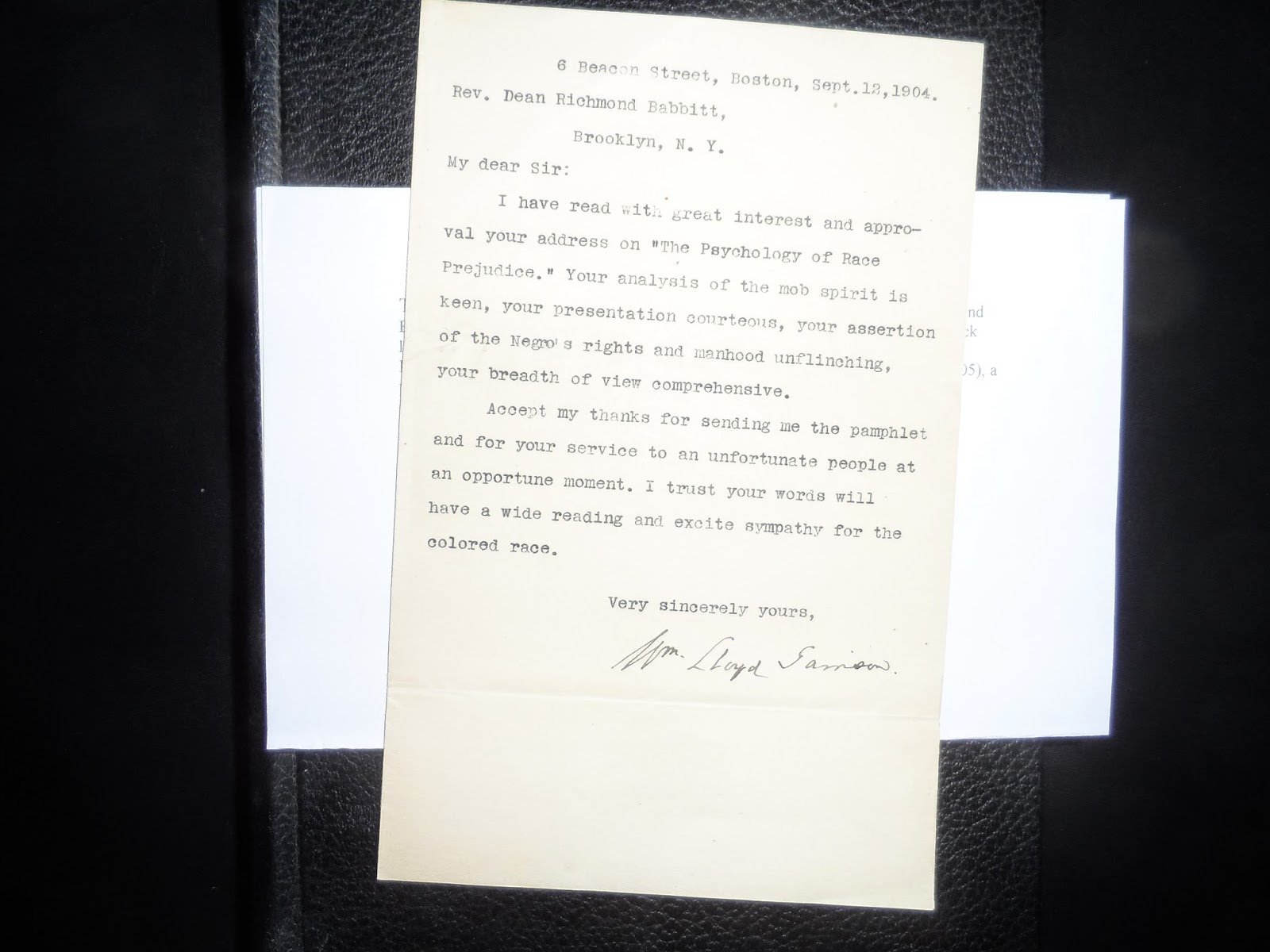
Various newspaper accounts that I have found indicate that Babbitt had become recognized as something of an authority on the subject.  Inserted in the typescript is a letter from William Lloyd Garrison praising The Psychology of the Lynching Mob.


THE William Lloyd Garrison who published the Liberator died in 1879, but his son of the same name had continued in his father's footsteps.  The introduction by William James and dedication to Theodore Roosevelt also indicate that Babbitt was someone to be taken seriously.

They typescript is dated 1906 with the name Paul Munter under the year.  It seems likely that this was the very Paul Munter who took fifth place in the Typerwriting Championship that was held in Madison Square Garden that year.

The Typescript

I'm hoping that someone with better skills than might help get this into easier form.  I have photographed the various sections and put them into manageable pdfs, which have to be downloaded.  I have two pdf files that contain the whole thing, but they seem to be unmanageable.  If there is a better way to do this, feel free to instruct me.

Table of Contents, Preface and Introduction by William James

Contents

History of the Term Lynch and study of American lynchings 1775 - 1850

(Although we normally associate the term with hanging, Reverend Babbitt shows that it originated with all sorts of non-judicial punishment, usually not capital in nature)

The Psychology Of Race Prejudice

The Psychology of The Lynching Mob - Part 1  - Part 2

Crime Against Womanhood Part 1 - Part 2

The Wilmington Lynching Part 1 - Part 2 - Part 3

On the night of June 22, 1903 a mob stormed the jail in Wilmington Delaware and seized accused murderer George White, dragged him to the scene of the crime and burned him at the stake.  Reverend Babbitt went to Delaware immediately after the event and interviewed local officials and some participants.  This particular lynching was the impetus of the Chautauqua conference at which Babbitt and Graves both spoke.  Babbitt reported his investigation in newspaper stories and discussed it in his Chautauqua speech, but I believe that this unpublished version may be more complete.

South's Treatment of The Negro

Northern View of Reconstruction

South's Hatred and Persecution of The Negro

Danger To The Nation

Tragedy of The Negro Woman

Fear Of Negro Dominance Groundless

Public Opinion A Corrective

Remedies For Southern Race Prejudice

John Temple Graves Chautauqua Speech - Part 1 - Part 2

Babbitt'Chautauqua Speech - Part 1 - Part 2


Any serious student of the various disciplines impinged by this is welcome to come examine the original.  I can even provide you with hospitality.  I live in Central Massachusetts and my email is peterreillycpa@gmail.com.

I am a contributor to forbes.com, where I mostly write about taxes.


Friday, April 8, 2011

The Colonel and the Pacifist


Women’s suffrage, temperance, pacifism (called non-resistance) and communes (called “associationism”.  The 1840’s can seem a lot like the 1960’s.  Except for the temperance part.  The connection was most obvious in quotation from Henry David Thoreau that became quite popular.  In the 1960’s everyone was marching to a different drummer. Often it was the same different drummer, but life is full of those types of paradoxes.  “Reform” in the 1850’s, though started focusing on one all consuming issue.  Slavery.  Temperance and women’s rights went on the back burner.  Associationism was all but forgotten or converted into corporate paternalism.  Non-violence was, for the most part, entirely abandoned, with violent means being actively embraced.

Two Unitarian ministers illustrate this transition in two critical events.  They are Thomas Wentworth Higginson, the colonel and Adin Ballou, the pacifist or as he put it, the non-resistant.  They had a lot in common.  Their lives spanned most of the 19th century.  Higginson, born in 1824, was a generation younger than Ballou, who was born in 1802. The generational difference was a factor in their different views.  They both lived long lives Ballou dying in 1890 and Higginson in 1911.  In the roll of Unitarian Ministers, they might each get an asterisk.  Higginson was a graduate of Harvard Divinity School, but he only served two parishes for a total of eight years.  Newburyport, where he was dismissed for his anti-slavery views and “The Free Church” in Worcester, which he left to enter military service. After the war, he did not return to ministry but made his living as a writer.  His writing career was distinguished and it appears that he barely missed being included in the canon of 19th Century American Literature that included his friends Emerson and Thoreau.

Ballou spent almost his entire adult life in the ministry much of it as a Unitarian.  He was, however, a Universalist.  He came out on what was then the wrong side of the Restorationist controversy.  The Restorationists held that those who were sinful in this life would go through some sort of process rather than everyone going straight to heaven.  The Restorationists  position was sarcastically summarized by his older and more distinguished, at least with in the denomination, cousin Hosea as “So you think they need to be smoked a bit.”  Adin was also upset to observe Hosea manipulating two congregations into something of a bidding war for his services.  So on top of everything else, cousin Hosea must have been better paid.  At any rate, Adin’s heretical views caused him to leave Universalism and become a Unitarian.  He was not overall impressed with Unitarianism or Unitarians, but he appreciated the non-creedal principles that allowed him to belong.

Ballou was also a writer.  For many years, he published a newspaper to promote the Restorationist viewpoint.  In his later life, he supplemented his income by writing, producing the tomelike History of the Town of Milford and the even weightier, literally, History of the Ballous in America.  The former is prized as a collectible, at least in the Blackstone Valley.  The latter is, I understand, a heritage item among the numerous Ballou descendants of today. I own both.  I am not planning on reading them anytime soon.

His works of more general interest were his Autobiography, The History of the Hopedale Community and Christian Non-Resistance.  Adin Ballou was in no danger of being part of the canon that Higginson barely missed.

There are several important differences.  The age difference can account for their different views on non-resistance, which was generally rejected by the second generation of abolitionists, much to the chagrin of William Lloyd Garrison.  Their other major difference is their relationship to the intellectual life of New England.  Higginson, although not wealthy, was an insider.  His father had been treasurer of Harvard.  He attended Harvard himself having a distinguished academic career.  He was one of the founders of Atlantic Magazine and a frequent contributor.  He lived much of his life in Cambridge and Newport.

Ballou was untouched by academic training at the college level.  Although he did not grow up in dire poverty, his father was too cheap to send him to college.  I suspect that if he had gone to college, we might have lost one of the 19th century’s most original thinkers. Except for a brief time in Brooklyn, he spent his career in the Blackstone Valley serving in Milford, Mendon and Hopedale (Hopedale being the town that his community morphed into).


What I have identified as the critical events for each of them occurred around 1855.  In the grand scheme of “Reform”, we might consider Higginson’s life leading up to his event as a prequel.  His event marks his movement into the center stage, although never quite in the starring role.  Ballou’s long life after his event might be viewed as an epilogue.  Each of the incidents occurs around 1855.

There has been a somewhat tedious debate as to whether the American Civil War (or whatever else you might want to call it) was about slavery of “states rights”.  The debate can sometimes take the form of “Tastes Great” “Less Filling”.  I believe the answer is simple the war was about a state right, the right to secede from the Union.  If, however, you read the South Carolina Secession Ordinance and the Constitution of the Confederacy, it is hard to discern what secession is about other than slavery.  Much of the state’s rights part of the ordinance has to do with the federal government not cracking down on the states that allowed people to agitate against slavery and interfere with the return of fugitive slaves to their masters.  To the extent, we can take the Ordinance at its face value; we have to view Higginson and his ilk as a serious aggravating factor.


By 1854, Higginson was well established in Reform circles.  When a major temperance convention refused to allow women on its executive committee, Lucy Stone and he led a walkout.  He was one of those who called for a national women’s rights convention in 1850.  Although, he did not attend, he among those who did attend were Lucy Stone, Abby Kelley, Frederick Douglas and William Lloyd Garrison. 


The event in 1854 was quite dramatic.  Anthony Burns, a fugitive slave, was being held in Boston.  Attempts at legal redress had failed.  The Fugitive Slave Law was biased in favor of the claimant.  On top of that Burns had made a tactical error in admitting that he was the slave in question and coming up with a story to justify his trip north (He fell asleep on a ship that he was working on).  Extralegal methods were required.  Not long before a fugitive named Shadrach was freed by a group of black Bostonians walking in one end of the courthouse and out the other with Shadrach in their company.  Even in 1854, disunion was in the air.  The failure of Northern states to honor the constitutional rights of southerners to recover their rightful property was a provocation that must be suppressed.  It is estimated that the federal government ended up spending $50,000 on the rendition of Burns including a specially chartered ship and a company of marines (The rendition of Anthony Burns, unlike the recent Halls of Montezuma did not work its way into their hymn.  It seems that not all our country’s battles are worth remembering).  The amount spent was so far out of proportion to Anthony Burns’ economic value that a Richmond newspaper commented that more such victories would bankrupt the South.

The attempted rescuers of Burns faced several obstacles.  A rescue attempt was expected, so he was in a third floor room with barred windows and armed guards.  Most of the crowd were non-resistants.  Their “plan” was to stand in the street pointing and yelling “Shame, shame” as Burns was escorted to the ship by a motley crew including the Leathernecks.  Higginson and some others thought more direct action was required.  The final problem was that they were not very well organized or disciplined.  At least that was the view of the future Colonel of Infantry.

Signals got crossed and the group that battered down the door of the building where Burns was being kept was not as large as was hoped.  There was a confused struggle and one or more gunshots.  In the end, Burns was not rescued and James Batchelder was dead from one of the bullets fired.  If you look at the website of the US Marshals, you will see the roll of honor, marshals killed in the line of duty.  The second name on the list along with the date of death (May 24, 1854) is James Batchelder.  Unlike the fallen marshals to come in the next 50 years he was not killed in the Wild West by desperadoes.  He was shot a short distance from Faneuil Hall in Boston by otherwise respectable people.  He was not maintaining law and order on the wild frontier.  He was returning a runaway slave.

I don’t fault the marshals for counting Batchelder on their roll of honor.  The law is the law.  Marshals are marshals.  Dead is dead.  The killer of Batchelder, who, at least by his own account was not Higginson was never brought to “justice”.  If he had been clearly identified, there would not have been a Massachusetts jury to either indict or convict him. It was a bit, like what went on in Mississippi one hundred years hence.  Only they finally got those guys.  Higginson suggested that they take up a collection for Batchelder’s widow, but the suggestion didn’t get very far

After the attempted rescue of Burns, Higginson just went from bad to worse as far as the defenders of the status quo were concerned.  Because of the Fugitive Slave Law, runaways were not really safe until they reached Canada.  Higginson declared that form henceforth Worcester would be Canada.  A slave catcher did once attempt to operate in Worcester.  He only got out of the city alive because Higginson and a group of abolitionists escorted him to the railway station.  One of the escort group kicked the guy in the ass every time Higginson wasn’t watching.

The next step in the radicalization of Thomas Wentworth Higginson was the Kansas issue.  The Missouri compromise, which had dictated the legality of slavery in newly admitted states based on their geographical relationship to the Mason Dixon line, had been superseded by the concept of “popular sovereignty”.  The residents of the territory would vote on whether slavery would be allowed.  The slaves didn’t get to vote nor did women for that matter.  In practice, though there was a significant liberalization of electoral qualification.  For practical purposes, you didn’t have to be a resident.

This gave the pro-slavery forces an edge.  They could just stroll over from Missouri, vote and go back home.  Abolitionists, on the other, hand actually had to go to Kansas, which is somewhat further from New England than is Missouri.  They went there to stay.  There was a New England Emigrant Aid Society to help them on their way.  The situation in Kansas became a violent convoluted mess.  It was referred to as Bleeding Kansas and Bloody Kansas in reference to the violence, but it could well be called bloody Kansas in the English sense of an annoying mess.  There were two legislatures for a while.  It became a sacred cause of democracy to not require that the constitution created by a convention elected through clear fraud be not put to a vote of the present residents.  This of course was coming from people who thought that their equal rights were being infringed because they couldn’t take their slaves wherever they felt like taking them.

Higginson went to Kansas and wrote about his adventures there.  He befriended an abolitionist notorious from what was called the Potawamie massacre.  Higginson would ultimately write an article for Atlantic on the man’s family.  More significantly, he befriended him and helped support his next enterprise.  Thomas Wentworth Higginson, along with Theodore Parker, was one of the “Secret Six” that helped financing John Brown’s raid on Harper’s Ferry.  Besides throwing a scare into the South, the reaction to the raid in the North where Brown was openly mourned was an outrage.  The raid on Harper’s Ferry is much better known than the Anthony Burns rescue.  It was also botched much more dramatically with several of Browns men killed on the site including one of his sons.  Higginson’s involvement as a backer in the affair gave him the experience of being on the wrong side of the law.  None of the Secret Six were ever prosecuted for what in effect was a treasonous plot.  Casualties on the side of law and order were much lighter but one Marine was killed in the assault on Browns redoubt.  Private Luke Quinn is sometimes considered the first casualty of the Civil War, but, in his auotbiography, Higginson gives the honor to James Batchelder.  The Marshals came on the scene later and picked up the prisoners from the Leathernecks.  It would seem from the Burns incident that they learned to send in the Marines as the first to fight for right (as then understood) if not for freedom.

Higginson was not done. When war broke out, he took a commission as a captain in a Massachusetts regiment.  Soon though he was offered a colonel’s rank as commander of the First South Carolina Volunteers.  He had not switched sides.  FSCV consisted of recently liberated slaves.  Higginson was the ideal officer to command them.  Unlike many white officers, he had developed a high opinion of the fighting abilities of African Americans from his abolitionist days.  He recognized their peculiar speech as a dialect worth studying.  After the war he published a collection of spirituals that he gathered by listening at the fringe of the campfires.  In my opinion this was more important than Emily Dickinson’s poetry probably his greatest source of editorial fame.  Under Higginson the regiment was on the fringe of the war and had no great military accomplishments.  They captured Jacksonville Florida but the high command did not think it was worth hanging onto.  He played a critical roll though.  A more typical bigoted officer might not have had the confidence in his men that was necessary to train them.  He might even have provoked a mutiny.  If this had caused an abandonment of the experiment with “colored troops”, the effect might have been profound.  Over one million men served the Union in what became a war of attrition.  178,000 were African American.

Ballou’s incident is not nearly exciting as the Burns rescue attempt.  As a matter a fact, although it clearly happened in some form, we do not have a good description.  I like to think of there being a meeting although it might have been Adin reading a letter or a memorandum.  What was the topic of the meeting?  Be still my beating heart.  Adin was being taught about “depreciation” a concept he had overlooked not being a person well skilled in finance.  Could three men sitting in a room calmly discussing accounting principles be as fraught with significance as an incident involving a company of marines and the gunning down of a US Marshall?  Well maybe not as fraught, but fraught enough.

The community founded by Adin Ballou was one of several intentional communities founded in the period between 1830 and 1850.  In a bit of hyperbole Emerson wrote that every man had the constitution of a new community in his pocket.  The three most commonly mentioned are Brook Farm, Fruitlands and the Northhampton Association.  Brook Farm is by far the most famous having the luck, good or bad, to be the model for the fictional Blithedale of the Blithedale Romance by Nathaniel Hawthorne, an occasional visitor, who defaulted on his financial pledge to the community.  Ballou’s community ran longer than the three of them put together.  Known variously as Hopedale and Fraternal Communion One (in retrospect Fraternal Communion One and Only) embraced most contemporary ism’s – abolitionism, pacifism, feminism and temperance.  At its core was a Christian Perfectionism that renounced all forms of coercion based on violence.  This did not just mean not serving in the militia.  It also meant not voting, serving on juries or suing.  Ultimately, all “carnal” government rests on force.

The economic system was perhaps the most significant feature.  The community was organized as a “joint stock company” which seemed to have some of the attributes of a contemporary limited liability company.  The organization was meant to navigate the dangerous channel between the Scylla of communism and the Charybdis of unbridled capitalism.  Those who provided capital were entitled to a limited return either 4% or 6% and wages were not equal, but rather were limited to those of “a first class operative”.  After 17 years, the community was doing so well that Adin thought he could hand off the leadership and focus on the Practical Christian Republic, which would be a network of Hopedales, ultimately covering the world.  Grandiose as the scheme may appear, he was better grounded than most such visionaries.  Hopedale was real and it seemed to work.  As a matter of fact, it probably really did work until George Draper convinced Adin Ballou that it did not.  Which brings us to the incident.

On February 5th 1855, the financial report of the community was presented.  It showed assets of $65,420.24 and liabilities of $65,270.09 for a deficit of $145.15.  The community did not have a negative net worth however.  Included in “liabilities” was $41,300 in joint stock.  This was the amount of money that had been contributed by members.  Thus, the community was in a strong position from a balance sheet viewpoint.  In calculating the net income that had produced the small deficit there were payments for labor of community members of about $16,000. 

At our presumed meeting, though, George Draper says to Adin.  Ah Reverend Ballou, but have you considered depreciation?  Depreciation?  Yes, there should be journal entries decreasing the carrying value of tangible assets to reflect wear and tear.  What would your deficit be then?

William Draper, George’s son, in defending what amounted to his father’s hostile takeover of the community made much of the depreciation issue.  He saw that as a reflection of the community’s poor accounting.  He related the story of a tool.  The original cost was never depreciated and even worse each time there was a repair the cost of the repair was capitalized increasing the book value of the used tool.  If you, like I, reminisce about the famous frauds through the ages you will recall that this was what they were doing at World Com.  If earnings were, off they would decrease repairs and increase fixed assets to get back on target.  It doesn’t hold a candle to the complex machinations at Enron, but it got the job done.  The World Com boys wouldn’t have fooled William Draper who learned good fixed asset accounting from his dad, George.  There is one little hole in his analysis though.  Included in the Hopedale balance sheet was about $145 in tools.  If the single overvalued tool that so horrified the Drapers, father and son, were the only tool and it was effectively worthless, the assets of the community would be reduced by less than 1%.

Adin thought that George gave the community a good deal by arranging that none of the members would be responsible for any debts.  Subsequently he bought brother Ebenezer’s share of the enterprise in order to sell it to son William – at a profit.  William resented that at the time but later in life came to believe that it was character building.  You can read about this sad story in a book called from Commune to Company Town.  You must go hunting if you want to find the story of the tool.  It appears in William Draper’s autobiography, which is not easy to come by.

After the war, Higginson mainly focused on his literary career.  He made some trouble on the Newport school board when he tried to get them to integrate.  He served a term in the Massachusetts legislature where he worked for woman’s suffrage.  Some New England abolitionists put their belief in equality aside when dealing with the Irish immigrants in their midst.  Not so Higginson who also campaigned to not force Catholic children to read the King James Version of the bible in the public schools.  One of the first instances of intolerance that he had witnessed as a child was the torching of the Ursuline convent in Charlestown.  Higginson’s consistency on human rights issues produced an interesting result.  When one of his proposal for woman’s suffrage was introduced, two Irish legislators walked off the floor.  When he asked them later why they had done so the answer was that they didn’t agree with his proposal, but they could not bring themselves to vote against him.  In the twilight of his life, he spent time opposing the new imperialism of the US coming out of the Spanish American War.  He died in 1911.  At his funeral there was an honor guard of African American soldiers.

Ballou spent the rest of his life as a minister.  He wrote several books including a History of the Hopedale Community in which he confessed to his ignorance of fixed asset accounting to be a major factor in its downfall.  He died in 1890.  William Draper paid for a statue of him to be erected.  Before funding the statue Draper made certain that, other people were paying for the land.  Hopefully whoever owns the statute has been recording appropriate depreciation deductions.

In terms of the advancement of human rights it is hard to not believe that the violent means advocated and practiced by Higginson accomplished much more than the non-resistance of Ballou.  The war, which Higginson gives himself a lot of credit for winning (Without Higginson, First South Carolina fails.  Therefore Union does not have 178,000 “colored troops”, which arguably tips the balance) gave us the 13th, 14th and 15th amendments. The latter two were not, however, well enforced until the 1960’s.

Ballou in the introduction to his autobiography wrote:

Times and generations are coming that will justly estimate me and my work, and assign both to their proper place in the providential plan for the progress and redemption of humanity.  For them, as it has proved, have I lived and labored, rather than for my contemporaries.  To them I appeal for vindication and approval; to them I bequeath whatever is valuable and worth preserving of my possessions
It can sound like the sour grapes of “I could have been a better leader if they had just given me better followers”.  However, there is actually something to be said for his view.

The image I like to pick to support his thesis is a Norman Rockwell print.  We see a little black girl surrounded by four men in suits.  To emphasize the difference in size we do not even see their heads.  They are wearing yellow armbands.  The yellow armbands were to identify them as US Marshalls.  They are escorting Ruby Bridges to her first day at school.  What would James Batchelder or the marshals that took John Brown off the hands of the marines had thought?  I would like to think it would be “Marshalls are Marshalls.  The law’s the law.”  No Marshalls went on the role of honor that day.  No marines were required, although in a similar drama at a high school in Little Rock paratroopers were brought in.  By truck.  Oddly enough this particular struggle had begun in Kansas over school integration.  It was definitely less exciting than the violence in Bleeding Kansas, but the Brown decision is today better remembered.  The Supreme Court had gotten into the act contradicting Justice Tawney’s holding in the Dred Scott decision that African Americans had no rights a white man was bound to respect.

When we think of the civil rights struggle of the fifties and sixties the figure that comes to mind is Martin Luther King, who preached not “non-resistnace” but rather non-violent resistance.  The people who fought with him faced violence.  The faced it unarmed.  Some of them died.  By the reckoning of the civil rights time line on Information please there were 11. 

I’m sure with careful research you could come up with more, but surely nothing like the 600,000 that died in the war.  Or even the five thousand that fell on one hot day in a place in Maryland called Antietam or Sharpsburg depending which side you were on - even after 9/11 the deadliest day in American history.  Probably not even the 150 Harvard graduates that Higginson helped memorialize.  It is counter intuitive that unarmed resistors were much less likely to be killed than those who were armed, but that is how it worked out.  What does this have to do with Ballou?

It is fairly well know that Martin Luther King followed the lead of Gandhi.  Gandhi was influenced by one of Higginson’s friends Henry David Thoreau, but more so by Leo Tolstoy.  However, who influenced Tolstoy ?  In the Kingdom of God is within he tells us


Another champion of non-resistance has been overlooked in the same
way--the American Adin Ballou, who lately died, after spending
fifty years in preaching this doctrine.  Lord God, to calmly and
meekly abide the doctrine.  How great the ignorance is of
everything relating to the question of non-resistance may be seen
from the fact that Garrison the son, who has written an excellent
biography of his father in four great volumes, in answer to my
inquiry whether there are existing now societies for non-
resistance, and adherents of the doctrine, told me that as far as
he knew that society had broken up, and that there were no
adherents of that doctrine, while at the very time when he was
writing to me there was living, at Hopedale in Massachusetts, Adin
Ballou, who had taken part in the labors of Garrison the father,
and had devoted fifty years of his life to advocating, both orally
and in print, the doctrine of nonresistance.

Tolstoy goes on to quote from Ballou’s work extensively concluding

I mention all this to show the unmistakable interest
which such works ought to have for men who make a profession of
Christianity, and because one would have thought Ballou's work
would have been well known, and the ideas expressed by him would
lave been either accepted or refuted; but such has not been the
case.

Ballou died in August, 1890, and there was as obituary notice of
him in an American journal of Christian views (RELIGIO-
PHILOSOPHICAL JOURNAL, August 23).  In this laudatory notice it is
recorded that Ballou was the spiritual director of a parish, that
he delivered from eight to nine thousand sermons, married one
thousand couples, and wrote about five hundred articles; but there
is not a single word said of the object to which he devoted his
life; even the word "non-resistance" is not mentioned.

Two ahisotorical thought experiments come into my mind when I think about this.  One is the pragmatic one.  Although it involves throwing around some arbitrary numbers, it is within reason that you could have bought all the slaves for what the war cost.  One of the reasons that this would not have happened is that many of those opposed to slavery were only against its expansion and actually, they were as opposed to having free blacks move into their states and territories, as they were opposed to slaves being brought in.  Nonetheless, it has a special irony.  One estimate of the total value of all slaves was 1.6 billion dollars.  The war cost the Union in current money alone on that order.  Towards the end, it was running a million dollars a day. (This with privates earning $13 per month, unless they were black). Imagine if those resources had gone into building infrastructure instead of destroying it.   

The other thought experiment has somewhat more plausibility, though not much.  It was dangerous to be an abolitionist, but it really depended on where you lived.  It was not much of a problem if you lived in Worcester Mass, but Charleston SC was a different story.  The Grimke sisters decided to make themselves scarce from their native city.  To go to Charleston, stand on the church steps, and give a speech that said slavery was wrong would have been suicidal.  The thought experiment is to ask what would have happened if they had done it any way.  They wouldn’t have hung William Lloyd Garrison.  Hanging would have been much too good for him; something particularly gruesome would have to be thought up on the spot. Run of the mill abolitionists though would probably have been hung after maybe being given a chance to learn their lesson with a good thrashing like the one Charles Sumner received on the floor of the Senate.  But what if they kept coming?  Would they have hung the Grimke sisters and Abby Kelley? If we were to start in 1855 say how many people they would have been willing to hang every day in Charleston just for saying they thought slavery was wrong ?  If they hung 100 per day for the next ten years, they still would not have come close to the lives that the war took. 

Of course, you could not find the 365,000 people that it would take to do that although I think they would have stopped well before that.  But they were able to find over 1,000,000 men to go down there armed which, again counter intuitive as it might seem, was probably even more dangerous. 

A contemporary Unitarian Universalist  parish would probably have no qualms about hiring somebody like Thomas Wentworth Higginson.  He would fit right in.  Ballou’s brand of unbending Christian Perfectionism would probably not go over all that well.  His poor record of fiscal management would probably not be held against him though.  But when the country picked one African American to honor with a holiday it was not someone that Higginson celebrated in his series of articles on slave revolts  like Denmark Vesey or Nat Turner.  It was Martin Luther King whose principles trace straight back to Ballou.