Showing posts with label Margaret Fuller. Show all posts

Monday, June 26, 2017

Scholar Goes To Rest With Margaret Fuller

Some stuff you just can't make up and the final chapter, perhaps the epilogue, in the life of Marie Olesen Urbanski Whittaker is like that.  This being my blog and all, I'm going to tell it from my point of view, which may seem a bit improbable.

Let's Make A Movie

Some years ago, I became obsessed with the notion that the life of Margaret Fuller needs to be a major motion picture.  My vision of it is as the most romantic tragedy in American history - brilliant young woman associating with iconic intellectuals, smarter than all of them, leading women in discussion of empowerment, authors fundamental feminist text, uses a platform as a literary columnist to examine issues of class race and gender, covers a revolution, marries a man ten years her junior who probably couldn't read her books but worshiped her, participates in a revolution, dies in a tragic shipwreck with her husband and son.

When I first heard about Margaret Fuller in 1972, it was as a marginal literary figure.  Editor of a journal that had a short life and a short print run inspiration for Zenobia in Blithedale Romance.  That was pretty much it.

It took a virtual lifetime of random unsystematic reading focused on the ante-bellum social reform movements for me to rediscover her. Unlike most Margaret Fuller scholars I am much more interested in the Civil War, abolition and the womens rights movement than I am in literature. To many Margaret Fuller is kind of a marginal Transcendentalist.  To me the Transcendentalists, the whole lot of them, are mainly important as a launching platform for Margaret Fuller.

Regardless, my nonliterary background may be why I think the film treatment is so important.  As luck would have it I know  Jonathan Schwartz of Interlock Media.  He convinced me that we needed to do a documentary first.  That and the best bonus I had in my career launched the project which has been going on for quite a while.

The Talent Scout

I mention all this to explain the improbable assignment I had last year.  I was a talent scout for Interlock Media.  Me.  A CPA.  A writer of sorts, but one who writes mostly about taxes.  I count myself among the most literary of the tax bloggers.  I mean check out my coverage of JD Salinger's estate planning problems.  But really not much of a literary person.

At any rate my tax blogging has honed my otherwise pretty good research skills making me not so bad at finding experts in this or that to add color to my stories. We had interviews with two major Fuller biographers already shot and my mission was to find some other scholars.

An Elusive Scholar

One of the more elusive was Marie Mitchell Olesen Urbanski author of Margaret Fuller's Woman in the Nineteenth Century: A Literary Study of Form and Content, of Sources and Influence  which was published in 1980.

The work was Professor Urbanski's Ph.D thesis. She had gone after the degree when she was already in her late forties, but still managed to land a position at the University of Maine.  And it was there that she did the thing that really won my heart.  In a site called Walking Tour About UMaine Women, I found:
The university’s “Gender Equity Plan for Athletics” exists to guide UMaine in its continuing efforts to maintain gender equity in its intercollegiate athletics program. We have come a long way since the 1970s when an English professor by the name of Marie Urbanski led a group to demand that women be allowed to use the weight room.

I still couldn't find her though.

I knew Marie had a daughter Wanda Urbanska (the feminine of Urbanski).  Wanda is herself pretty famous.  Among other things she had a series of simple living that ran on PBS


I was having trouble finding her too, but I finally struck gold with a story in the New York Times - Three Generations, Two Comfy Homes a Few Steps Apart

For Ms. Urbanska, a media consultant and author, the economics of shared living have eased some of the financial pressures she faces as a single mother. Together, she and her mother, Marie Whittaker, bought the three-bedroom home for $370,000 last year. They each contributed $60,000 to the down payment, which consumed a considerable portion of their liquid savings, or money that was not tied up elsewhere.
Well - what can you say? Despite being the very model of a second wave feminist, Marie had apparently changed her name again when she remarried.

Hurry Up

From there it was not too hard to get Wanda on the phone.  Wanda was pretty impressed with the depth of my knowledge.  She told me her mother was still quite sharp, although she had some trouble hearing, but if we wanted to film her we shouldn't put it off, because she was pretty old.  Here is the note from our prospect file:
It turns out that Marie is still alive alert and very feisty and outspoken as reported by Wanda who is delighted that we called and impressed by the depth of our research. She was very much involved in her mother's work.
Marie is going strong. Wanda said that she is holding on so that she can vote for the first woman president.
Wanda is also familiar with production and could help with logistics on a North Carolina shoot.
Too Late

Sadly we could not get it together.  Not long after we talked I got a sad email from Wanda
It was so good to speak to you earlier this month about the scholarship of my mother, Marie Olesen Urbanski Whittaker, on Margaret Fuller. I had indicated that you should move quickly if you were planning to film her, but I didn't realize how quickly she would go. She died on Oct. 24.
Wanda included links to obituaries in the Raleigh News & Observer  and The Mount Airy News.  Best though was the story Wanda wrote for Glamour - The Last Thing My Mother Did Before She Died Was Vote For Hillary Clinton.  They have early voting in North Carolina, which Marie took advantage of. As Wanda relates it:
This Monday afternoon, when I returned from the post office, receipt in hand, I stepped into the bedroom where Mama was barely hanging on.
"Did Hillary make it?" she asked once more, her words trailing, her voice almost inaudible. Looking at the fading light in her eyes, as her boney hand stretched out from her hospice bed, I considered how to respond. Do I tell her the truth? Hillary's poll numbers are looking positive, but the election is not in the bag.
"Yes, Mama," I told her. "Hillary made it."
It was what Marie Urbanski Whittaker had been waiting for her entire life. Within minutes, she was gone.
The post went viral and is pretty well known, although it is little noted that the story was about a pioneer Margaret Fuller scholar.  I found that out a few months later.

Independent Scholar And Margaret Fuller Fan Boy

By May Interlock had a fifteen minute version of the documentary ready.  I had moved from talent scouting to finding images and quotations.  A delightful part of that process was rereading Margaret Fuller Ossoli by Thomas Wentworth Higginson. You literary types will think of Higginson as a bad guy in the Emily Dickinson story whose reputation was helped by the recent White Heat.

Somebody like me though is a lot more interested in his role as one of John Brown's Secret Six and commander of the First South Carolina Volunteers (33rd United States Colored Troops).  It was Higginson's biography that drove home the Margaret Fuller story to me.
And as for Margaret Ossoli, her life seems to me, on the whole, a triumphant rather than a sad one, in spite of the prolonged struggle with illness, with poverty, with the shortcomings of others and with her own. In later years she had the fulfillment of her dreams; she had what Elizabeth Barrett, writing at the time of her marriage to Robert Browning, named as the three great desiderata of existence, “life and love and Italy.” She shared in great deeds, she was the counselor of great men, she had a husband who was a lover, and she had a child. They loved each other in their lives, and in their death they were not divided. Was not that enough?
At any rate the fifteen minute version of the documentary was shown at the American Literature Association conference.  Lacking any academic affiliation my ID badge denominated me an "Independent Scholar", which struck me as a little grandiose.

At Margaret Fuller's Home

There was a meeting of the Margaret Fuller Society  scheduled to coincide with the conference with a bus to take us from the conference in Copley Square to the Margaret Fuller Neighborhood House.  Margaret's childhood home in what was then called Cambridgeport has been a community center since early in the twentieth century (Thomas Wentworth Higginson, kind of the last of the Transcendentalists, was there at its original dedication).

As I talked to various Fuller scholars at the conference I found that although most of them were familiar with Marie's work, none of them seem to know her.  This is not entirely shocking.  She retired around the time that the Margaret Fuller Society was founded twenty five years ago.  And few were aware of her connection to the Glamor story.

So I ended up having the honor of making a little presentation on her at the meeting.  I of course included the story about the weight room.  If I didn't say "let them be weight lifters, if you will", I should have, so let's just say I did.  I concluded with something to the effect that she had gone to a better place where we have a different president.

One of the members dubbed me a Margaret Fuller fan boy and I think I might use that if I ever go to ALA again, but it gets better.

Resting With Margaret Fuller

I let Wanda know about the event and she was really pleased and then she asked if we could meet up.  She was going to be hanging out at Logan Airport to meet up with her sister to go to a wedding on Martha's Vineyard.

We worked it out and she met with me, Jonathan and one of his interns.  We were able to show her the fifteen minutes on one of our computers and had a great dinner.  Most interesting was that she had Marie with her.  Her ashes that is.  Jonathan figured she was going to divide them with her sister.  But that was not the plan.

Wanda and her sister, Jane Robbins, had a road trip planned.  After the Vineyard wedding, they were off to Fire Island where they would scatter Marie's ashes.  You and I both know that is where the Elizabeth went down with Margaret Fuller and her husband and son, but you have to consider the other readers.

I asked Wanda how it went and she wrote me:
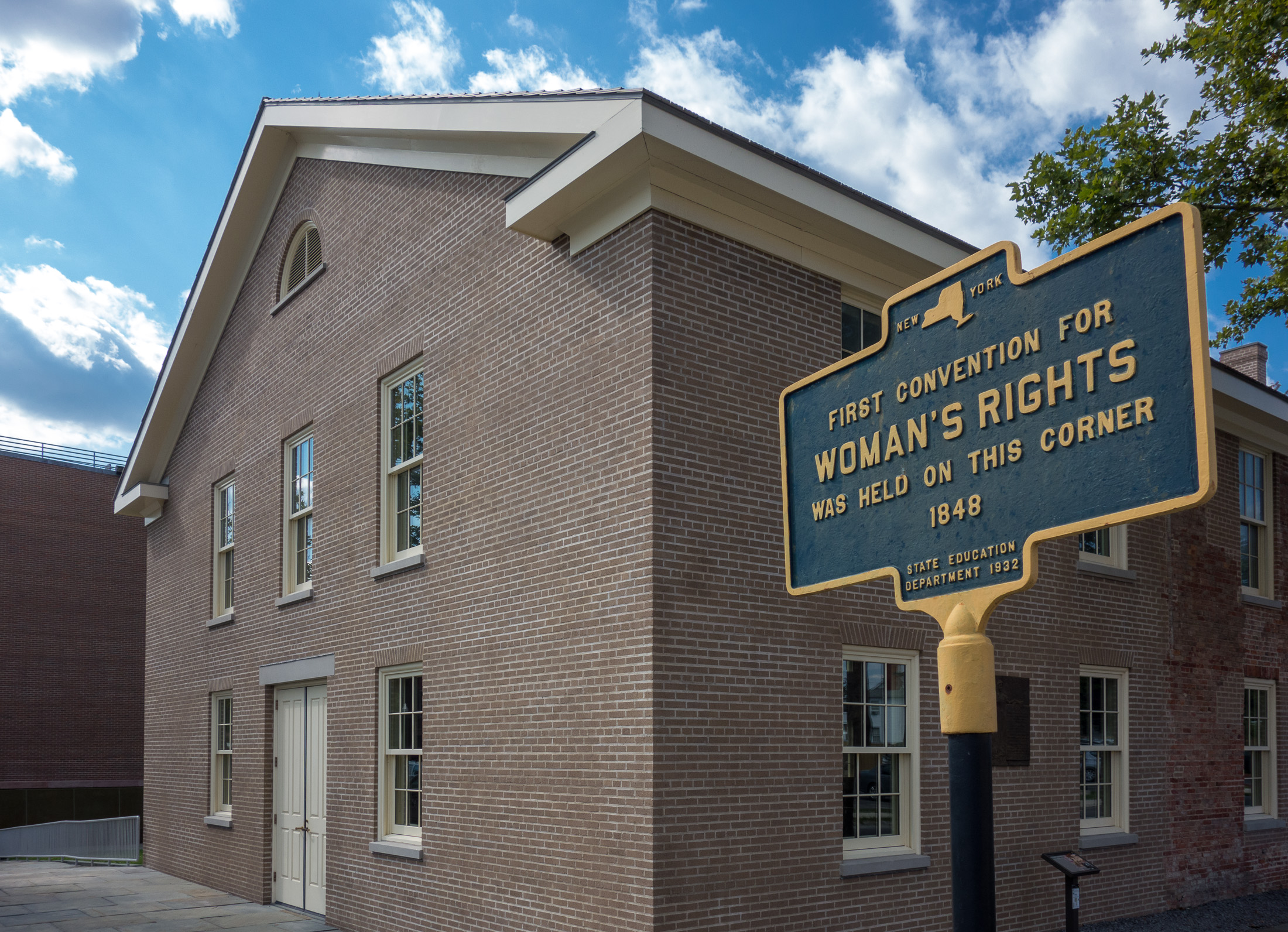
We scattered the vast majority of Mama's ashes off of Fire Island, as was her lifelong wish. We saved a smattering of ashes to scatter in Seneca Falls, NY, at the base of the monument to those who organized the Women's Rights Convention.
_________________________________________________________________________

Peter J Reilly CPA, Independent Scholar, Margaret Fuller Fan Boy is looking forward to the full length documentary and the feature length biopic that is sure to follow.  Tom Hanks will narrate as Thomas Wentworth Higginson, but we still don't know who should play Margaret Fuller..



Thursday, November 3, 2016

Not Every Women's Rights Narrative Starts At Seneca Falls


.....memory is made, not found and what we remember matters. - Lisa Tetrault
This post is something of a personal reaction to The Myth of Seneca Falls: Memory and the Women's Suffrage Movement by Lisa Tetrault, so I should start with the most important thing before I go into the wandering digressions.  It is a really good book and you should read it.

Some People Don't Get It

The most negative review on Amazon (a three star) highlights by omission what is really good about the book.
This book does reveal some nuggets of difficult to find information and the author is obviously extremely knowledgable and gifted but the book contains too much run-of-the-mill, feminist cheerleading and the revealing information in the book is revealed in a way that makes it seem as though it was included almost as an afterthought.
The book is overly verbose and should have been half its length but the author has a bad tendency to lapse into moments of drawn out flattery of the movement which we've already heard a thousand times. Even though the suffrage movement obviously deserves some cheerleading this book pours on the cheese a bit too much to warrant a higher rating.
The key words in the title are Memory and Myth.  Lisa Tetrault's work is about how and why we make narratives about the past using a reasonably familiar (in some circles) narrative,illustrating its incompleteness and more importantly how and why that particular narrative was constructed.

Historiography

I could see this work becoming not only a standard text in women's studies or the history of social reform, but also in historiography , which the infallible source tells us is "the study of the methodology of historians in developing history as an academic discipline, and by extension in any body of work on a particular subject".

Tetrault quotes historian Lori Ginzberg:
Every event in history is a beginning, a middle and an end, it just depends on where you pick up the thread and what story you choose to tell.
Sam Gamgee made the same point:
We've got - you've got some of the light of it in that star-glass that the Lady gave you! Why to think of it, we're in the same tale still! It's going on.  Don't the great tales never end?
'No, they never end as tales, said,  Frodo. 'But the people in them come, and go when their part's ended
Frodo of course. recognized the essence of historiography in this clip.


 Nothing like referring to the world's greatest bromance in a reaction to a great work on women's history.  Back to the book.

The Myth

The "myth" under discussion in this work is illustrated in the National Women's History Museum's Woman Suffrage Timeline (1840-1920).
1840
Lucretia Mott and Elizabeth Cady Stanton are barred from attending the World Anti-Slavery Convention held in London. This prompts them to hold a Women's Convention in the US.
1848
Seneca Falls, New York is the location for the first Women's Rights Convention. Elizabeth Cady Stanton writes "The Declaration of Sentiments" creating the agenda of women's activism for decades to come.
Due credit is given to conventions in Worcester in 1850 and 1851, which I have a particular attachment to, but beginning in 1853, the partnership between Elizabeth Cady Stanton and Susan B, Anthony starts to dominate, with Susan B. Anthony taking the limelight.  To take a biblical analogy, Elizabeth Cady Stanton would be John the Baptist making Susan B. Anthony, well, you know.

Tetrault's work is about how that story became THE story. And it is not just about how Susan B Anthony became the main actor in the story, but also about how suffrage becomes the big story about women's right, white women's suffrage actually, since the 19th amendment did not help black women vote in the South, where black men had been systematically disenfranchised.

Like The Late Unpleasantness 

Tetrault connects the story of the creation of the women's rights narrative to that of the construction of the narratives that help us remember slavery and the war with many names (Civil War, War Between the States, War of Northern Aggression - personally I prefer The Late Unpleasantness)

The fierce debate - over competing definitions of freedom - took place in the arena of memory.  It was not the only arena, but it was a critical one.  Because freedom had no inherent self-evident meaning, Americans debated its definition by attempting to define the past. Why had the Civil War been fought? Answers to that question, which varied widely, defined different paths forward.  Had it been fought, as freedpeople and abolitionists argued for emancipation? If so that required a postwar political response that validated the needs of freedpeople and invested freedom with significant weight?  Or had it been fought, as white supremacists argued, for valor, honor, and states' rights? If so, that required a postwar political response that elevated the rights of white Confederates over the rights of freedpeople, whose needs were largely erased by such a memory.
More Than A Counter-Narrative


I'm now going to be seguing from reviewing the book to my rambling personal reaction, but to sum up I will react to one of the five star reviews.
The publication of "The Myth of Seneca Falls" is a big event for those of us who like to live in the suffrage world. Professor Tetrault has come up with the first really effective counter-narrative to Eleanor Flexner's classic "Century of Struggle".
I really don't view Tetrault's work as a "counter-narrative".  It is much more than that.  It is a narrative of the making of the received narrative that suggests many other narratives that might be constructed and from there I will move to my personal reaction.

Searching For Margaret Fuller


I discovered Professor Tetrault's work from a hunt that someone had sent me on.  The question as I might frame it now, having read Myth of Seneca Falls, was why Margaret Fuller, who, Margaret Fuller scholars consider with substantial support, a women's rights pioneer of the highest order, whose Woman in the Nineteenth Century was published in 1845 whose Conversations, arguably the 1840 version of second wave consciousness raising groups, included Elizabeth Cady Stanton does not appear in the Timeline.

It really would not be that hard.  Between 1840 and 1848, you put in 1845 publication of Woman in the 19th Century.  Fuller was in Italy covering and taking a hand in a revolution in 1848 when Seneca Falls took place.  She had been invited to preside over the first national women's rights conference in Worcester in the fall of 1850.  Sadly her only participation  was in spirit during a moment of silence as she lost her life in the wreck of the Elizabeth, a 530 ton sailing vessel, that grounded off Fire Island on July 19,1850.

Professor Tetrault, answers the question even though her work does not even mention Margaret Fuller.  In the received narrative the story really starts in Seneca Falls and focuses on Susan B. Anthony who is first mentioned on the timeline in 1853, but along with Stanton dominates it through the post-Civil War period. The received narrative was largely the creation of Susan B Anthony and Elizabeth Cady Stanton.  Not only are they center stage, but there is also a singular focus on suffrage.

Many Narratives

Probably, the most important thing we can learn about history is that there are many valid narratives that can be crafted from the raw material of the past.  We can ask different questions of different sources and derive different stories.  I think that many people when they encounter this reality find it rather disturbing.  I know I certainly did when I asked my father how it was that Robert E Lee, chief bad guy in the Civil War, was accounted a national hero appearing on postage stamps.  The budding neoabolitionist never got a good answer from his old man.

Professor Tetrault is an historian and they tend to be a bit allergic to counterfactuals, but as a graduate school dropout who loves Harry Turtledove, SM Stirling and Eric Flint, I'm different.  Thanks to her book I am now in the grip of a profound counterfactual.  What would have happened if the Elizabeth had docked safely in New York and Margaret Fuller had presided over the first national women' rights conference in Worcester?

My favorite biography of Margaret Fuller is the one by Thomas Wentworth Higginson and in it he saw her mainly as a woman of action ready to unleash. It is just possible that she might have been able to galvanize a different reform movement than the one that fragmented over votes for African Americans versus votes for women in 1866.  In her work she addressed issues of gender, but also of race and class.  She was rare among New England Unitarian reformers in having kind words for Irish refugees, then the most despised white people in America.

Higginson's assessment deserves to be taken seriously, because he, himself, had strong activist credentials - the Anthony Burns rescue, John Brown, command of a regiment of liberated slaves (First South Carolina Volunteers - later 33rd United States Colored Troops).

But maybe it was too soon to have a holistic reform movement and maybe it could have turned out worse - like when Spock and Kirk had to stop McCoy from saving the life of the 1930's peace activist in The City on the Edge of Forever.


I'm sorry I don't have the talent to write "The Elizabeth Must Sink", but I can always hope that a talented alternate history writer might pick it up.

________________________________________________________________________

Peter J Reilly CPA hoped to be an historian, but public accounting has been good to him.


.

Sunday, June 29, 2014

Gettysburg Interlude - Understanding Historiography

This was originally published on forbes.com on July 5, 2013 as part as my Gettysburg Sesquicentennial coverage.  For the anniversary of the anniversary, I am putting this first.  The rest of the Gettysburg posts will be as close to real time as possible.  There will also be many more pictures than I put up on forbes.com
________________________________________________________________________________

Civil War enthusiasts.  Civil War buffs. Civil War nuts.  Call them what you want.  Despite my covivant's conviction to the contrary, I will not cop to being one of them.  The main evidence in my favor is that I embraced the Margaret Fuller bicentennial with much more enthusiasm than the Civil War sesquicentennial.  Gather 1,000 Civil War buffs in a room and I doubt you will find 20 who know who Margaret Fuller was.  When she died in 1850, she was the most famous woman in the United States of America.

Margaret Who ?

Born in 1810, Margaret Fuller inspired a generation of younger activists.  Among them was Thomas Wentworth Higginson one of the "Secret Six" who backed John Brown's raid on Harper's Ferry. Included in the  grievances that are listed in the Declaration of the Immediate Causes Which Induce and Justify the Secession of South Carolina from the Federal Union are these acts of the Northern states:
Those States have assume the right of deciding upon the propriety of our domestic institutions; and have denied the rights of property established in fifteen of the States and recognized by the Constitution; they have denounced as sinful the institution of slavery; they have permitted open establishment among them of societies, whose avowed object is to disturb the peace and to eloign the property of the citizens of other States. They have encouraged and assisted thousands of our slaves to leave their homes; and those who remain, have been incited by emissaries, books and pictures to servile insurrection.
So why don't Civil War buffs know who Margaret Fuller is ?  Or even Thomas Wentworth Higginson who would command a regiment and whose memoir, Army Life In A Black Regiment, is considered by some one of the best civil war memoirs.  In order to answer that question you have to think about historiography.

What is Historiography ?

According to the infallible source:
Historiography refers either to the study of the methodology and development of "history" (as a discipline), or to a body of historical work on a specialized topic. Scholars discuss historiography topically – such as the "historiography of Catholicism", the "historiography of early Islam", or the "historiography of China" – as well as specific approaches and genres, such as political history and social history. Beginning in the nineteenth century, with the ascent of academic history, a corpus of historiographic literature developed.
In order to understand what the Civil War means to people now and how it came to mean that, you have to study historiography.

Idiot's Guide To Civil War Historiography

To say that you can boil Civil War historiography into two schools might seem absurd, but I think a reasonable case can be made.  Among enthusiasts, on either side, the two schools are the right one and the wrong one or the things that "they" want you to believe and the truth.  As somebody once told me, my problem is that I am an Aquarian and want everyone to get along.  So I will refer to the two schools as Lost Cause and Neo-abolitionist.  Fortunately, I did not make either of those terms up so I can go to the infallible source for definitions.

Lost Cause
The Lost Cause is the name commonly given to an American literary and intellectual movement that sought to reconcile the traditional white society of the U.S. South to the defeat of the Confederate States of America in the American Civil War of 1861–1865.Those who contributed to the movement tended to portray the Confederacy's cause as noble and most of its leaders as exemplars of old-fashioned chivalry, defeated by the Union armies through overwhelming force rather than martial skill. Proponents of the Lost Cause movement also condemned the Reconstruction that followed the Civil War, claiming that it had been a deliberate attempt by Northern politicians and speculators to destroy the traditional Southern way of life.
Neo-Abolitionist
Neoabolitionist (or neo-abolitionist or new abolitionism) is a term coined by historians to refer to the heightened activity of the civil rights movement in the late 1950s and early 1960s. The term was soon used by leading historians to refer to the moral impulses of historians influenced by the Civil Rights movement in their studies of slavery, Reconstruction, segregation and Jim Crow. Bradley (2009) says, "Inspired by the civil rights movement, neo-abolitionist historians such as John Hope Franklin, Kenneth M. Stampp, and Eric Foner took their cue from DuBois and placed blacks front and center in their Reconstruction narratives." They led a re-evaluation of Reconstruction and its aftermath that focused on the significance of full citizenship and suffrage for African Americans. Thus Allen C. Guelzo (2009) refers to "the most recent neo-abolitionist histories from Henry Mayer and Paul Goodman" as well as "older neo-abolitionists like James McPherson, Howard Zinn, and Martin Duberman.".George M.Fredrickson (2009) says, "Neo-abolitionist historians profess to derive their standard from the abolitionists of Lincoln's own time."
Who Is Right ?

You have to be kidding to ask that question. Lost Cause believers and Neo-abolitionists ask different questions of different sources.  They can both tell true stories that are deep and rich and inspiring.  Lost Cause has one very serious weakness. In order to continue to believe wholeheartedly in the full Lost Cause narrative, you have to avoid reading material that is written in the South before 1862.  If you are a Lost Cause enthusiast, I would never try to talk you out of it.  I would ask that you read just one thing -  Declaration of the Immediate Causes Which Induce and Justify the Secession of South Carolina from the Federal Union.  Read it a couple of times and then explain it to me.  The only theory that I have been able to come up with is that it was really all about tariffs, but they were embarrassed about that, so they just said it was about slavery.

Why Did They Fight ?

When people start arguing about this they usually do it by setting up straw men that are relatively easy to knock over.  Nobody has ever seriously maintained that Northern soldiers were incipient NAACP supporters.  There were probably not that many officers who would give speeches where they said they were an army fighting to make other men free.


You will, however, find Lost Cause enthusiasts "proving" that they are right by showing how racist Northern soldiers were.  My own reading leans me towards concluding that a large portion of the Southern elite was very pro-slavery.  A very small portion of the Northern elite were militant abolitionists.  Regular folks - there is a lot of controversy and a lot of problems with the evidence.  The debates can make you a little crazy.  Maybe most Southern soldiers did not come from slave-holding families - depending on how broadly you define family.  On the other hand, if you are twenty years old and don't own a car or a house, it does not mean that you would not like to own one.  Clearly, though, to the extent there was an idealistic motivation for most regular folks, it was that bad guys were trying to take their country away.  Some of them thought they lived in a bigger country than others.
Why Can't We All Just Get Along ?
The Lost Cause had a pretty good historiographical run.  It served the interest of white people in both the North and the South.  And it is not as if you cannot find a lot to support it.  Lost Cause people may have buffed up the image of Robert E. Lee a bit, but they had really great material to work with.  Paul H. Buck explained the process in his Pulitzer Prize winning Road to Reunion in 1937.
The memories of the past were woven in a web of national sentiment which selected from by- gone feuds those deeds of mutual valor which permitted pride in present achievement and future promise. The remarkable changes that had taken place within the short span of a single generation had created a national solidarity hitherto unknown in American life. The reunited nation was a fact.
Lost Cause was not a purely Southern invention.  Even a governor of a Northern State, a Medal of Honor winner, wounded six times and promoted to Major General had a hand in it. Joshua Chamberlain wrote:
I was told, furthermore, that General Grant had appointed me to take charge of this parade and to receive the formal surrender of the guns and flags. Pursuant to these orders, I drew up my brigade at the courthouse along the highway leading to Lynchburg. This was very early on the morning of the 12th of April. ......

At such a time and under such conditions I thought it eminently fitting to show some token of our feeling, and I therefore instructed my subordinate officers to come to the position of 'salute' in the manual of arms as each body of the Confederates passed before us. .......
The General [Gordon] was riding in advance of his troops, his chin drooped to his breast, downhearted and dejected in appearance almost beyond description. At the sound of that machine like snap of arms, however, General Gordon started, caught in a moment its significance, and instantly assumed the finest attitude of a soldier. He wheeled his horse facing me, touching him gently with the spur, so that the animal slightly reared, and as he wheeled, horse and rider made one motion, the horse's head swung down with a graceful bow, and General Gordon dropped his swordpoint to his toe in salutation.
Around the same time that Road to Reunion was published Lost Cause entrenched itself firmly in popular culture.


For the last fifty years neo-abolitionism has been gaining ground.  It won the colleges early.  If you win the colleges, within a generation you have the high schools and the elementary school. The centennial was all Lost Cause all the time, but the sesquicentennial is heavily neo-abolitionist.  As you walk into the museum at the visitor center you see a sign that says in part:
Americans fought one another over three fundamental issues: the survival of the union, the fate of slavery, the common rights of citizenship - what it means to be an American -the war resolved the first two issues.  The nation struggles with the third to this day.
Now that is neo-abolitionist with a vengeance.

How Do We Get Along ?

We get along by practicing a form of apartheid.  The educational system is neo-abolitionist.  Popular culture remains Lost Cause to a significant extent.  The educational system does not pay very much attention to the actual war.  Civil War buffs do not pay very much attention to what happened other than things relating to the actual conduct of the war.  When I was a history major, one of the professors told me they did not offer a course specifically on the war itself, because when professors  did that they always ended up with a couple of pain-in-the-ass nineteen year old buffs who knew more than they did.  I'm sure that has evolved some, but when I was at the Pickett's charge event, a high school history teacher from South Carolina was grumbling about the curriculum not having anything about actual battles.

How Does It Work At Gettysburg ?

Gettysburg is ground zero for both interpretations.  I think what the organizers for the Sunday night televised event did was invite Doris Kearns Goodwin to the wrong party.  Her speech aggravated some people by being too much about Doris Kearns Goodwin.  It outraged other because of its reference to the DOMA decision.  When Doris Kearns Goodwin said "Stonewall", she was not talking about how the battle might have turned out had General Jackson not encountered friendly fire at Chancellorsville.  If Doris Kearns Goodwin had given the same speech four and a half months from now and a few hundred yards to the east, only the self-absorption would have been aggravating.  The high water mark and July 3 will forever belong to the Lost Cause and nobody should try to disturb that. Neo-abolitionists have a very strong claim on the Gettysburg address where it was reconfirmed that we are dedicated to the proposition that all are created equal.

My next post will be about the July 3 experience, which, like the Centennial, was all Lost Cause all the time.

You can follow me on twitter @peterreillycpa.

 Afternote

 Like many people I think of the rise of Neo-Abolitionist views as beginning around the 1960s.  Lost Cause enthusiasts will still refer to them as "revisionist".  A recent book I read The Southern Past - A Clash Of Race And Memory by W. Fitzhugh Brundage gave me a bit of a different perspective.  We will often think of Lost Cause as the Southern version, but that would be while accurate, perhaps imprecise.  Lost Cause is the white Southern version.  Black Southerners in their segregated schools learned a history that was more celebratory of emancipation.


Day 0 Pickett's charge reenactment not on the battlefield.


Monday, June 16, 2014

radfems to OWS Women - You Do Not Have to Get Arrested to be Assaulted


Originally published on forbes.com  on Octobter 23, 2011.  This was in response to the respone to an earlier piece of mine (a guest post by Tom Cahill actually) that had been picked up by radfemhub -a radical feminist collectivist blog.  Sadly radfemhub is just an archive now.  I began following contemporary radical feminism somewhat in earnest at this point.  I didn't become a convert, but I find that the belief system that it supports gives you a way of viewing the world that will cause you to see things that you might otherwise miss.  I did not think that I would ever have call to write about it again, but it turned out that I was mistaken. Stay tuned.
_________________________________________________________________________
Sarah Margaret Fuller Ossoli (1810-1850) a jou...

My friend Tom Cahill gave me a guest post that is timely in light of Occupy Wall Street to the effect that a brief stay in jail for civil disobedience can turn int0 a lifetime of post traumatic stress disorder if you end up being sexually assaulted. There were two words in Tom's piece that I considered cutting, since I thought them beside the point.  Anyway those two words got a reaction from fellow,  contributor Victoria Pynchon which you can check out.  More significantly the piece got quoted at length at radfem HUB.  My introduction and some of Tom's message got conflated with the whole thing be attributed to forbes, which is really a little funny if you know me and hilarious if you know Tom.  Regardless here is part of that piece: 

of course, most if not all women already ************ know that we are the targets of male sexual violence no matter where we go, and that prison-rape is a very real possibility for us too. we dont need to be reminded. so who is forbes talking to here? this is not a rhetorical question. importantly, the threat of men being raped in prison is also a really good ******** reason (for men) to not get the cops involved for any reason, lest some poor male be brutalized himself while in police custody. even where that man was arrested for sexually brutalizing a woman or women himself. getting the police involved could lead to men being raped. even when the cops get called because the men themselves have raped. which sheds some meaningful light on the anarchists’ motivations in every context, does it not? including how highly they value women, and protecting womens interest in not being sexually violated in general, and in not being sexually violated by them. and as jezebel reports, apparently theres alot of PIV going on at OWS too, which isnt really a surprise: keep the drugs, alcohol and sex-positivism flowing and hopefully none of the women will “cry rape” and kill everyones buzz i mean foul up the atmosphere of male-centric entitlement which hangs heavy over OWS and all male-centric political movements (including slutwalk) like a rain-soaked sleeping bag. can women just never escape our reality that we are fodder for sexually predatory men, even when we are politically-active and are trying desperately to evoke meaningful political change alongside men, on mens terms? radical feminists know the answer to that: the answer is obviously we cannot. when organizing with men, our role is and will always be primarily (or exclusively) as sexual commodities, helpmates and masturbatory aids

the reality is that OWS is a mens movement, and the treatment of the sexual predators in their midst as well as the male protesters’ PIV entitlement tells us everything we need to know.  women should be able to peacefully protest and be politically active without giving up their legal rights, or winding up impregnated, worrying about having been impregnated, and becoming trauma-bonded to the other protesters through dangerous male-centric sexuality.  this is complete and utter bullshit, and it doesnt help women.  thats the thing.  politically-active women should never be put in the position of being politically-active mens sexual service stations.  ever.  but this is in fact what we see, and it has been this way for decades.  politically-active women in the 1960s and 70s counterculture dealt with the same damn thing.  critically, there was little to no fundamental change with regard to womens social or political status or with regard to sexual politics as a result of that movement.  we must learn from this.

I don't know what it is about radfems and capital letters.  Maybe somebody will explain it to me someday.  PIV is I think a radfem term of art.  The "I" stands for in. PIV is what our former President meant by sex, when he said he did not have sex with "that woman".  The first place I wanted to go with this was back to 1840 as I already did when I wrote about Adin Ballou.  I saw the Occupy Wall Street critique of capitalism as taking up the unfinshed business of 19th Century Reform. The radfem critique of OWS immediatly made me think of Margaret Fuller. Margaret Fuller was probably the best educated person of her time.  She found that the Conversations she conducted with women did not work that well when men were admitted.  As a correspondent  for the New York Herald she visited and wrote about imprisoned prostitutes.  She did not let her Conversations be subsumed into the abolitionist movement.  The other feminists that she inspired with Woman in the Nineteenth Century came into women's rights through their experience in the abolitionist movement.  She had started there.  So I was thinking that the radfem critique of OWS could be something like Male Sexual Restraint - The Abandoned Business of 19th Century Reform.

My first consultation simplified the task for me.  I spoke with someone who has forgotten more about Margaret Fuller than I can ever hope to learn.  She agreed that MF would probably be with the radfems to some extent but she followed that up with a story about a demonstration that she went to.  She had felt safe with her compatriots and then found that one of them was carrying a gun and expected that she would be sharing his sleeping bag.

So whatever I may think about the radfem worldview and from their comment policies it is pretty clear that they don't care what I think, they are clearly onto something.  They have put together material to confront the bad behavior that is likely to go on at some of the occupations.  The title is Occupy Dudeville, which I have to say is pretty clever.  The chaotic environment and hesitancy to bring in the police does create serious risks particularly to women.  Actually even purely consenual PIV in that type of atmosphere is probably a really bad idea regardless of which letter you have.  PIV is best done between people who have known one another for a while in various circumstances and have a high level of trust.
The radfems don't want me commenting on their blog, but they are certainly welcome here.  I spoke with a young woman who was a senior majoring in gender studies, who did not know who Maragaret Fuller was.  I really hope that there are more people in gender studies who have read Woman in the Nineteenth Century than there are those who have never heard of Margaret Fuller.  Maybe I'll find that out someday.  Activists frequently do not pay enough attention to history and end up repeating the same mistakes.  It would be interesting to speculate on why, but I will leave that be for now.

Tom's Offense

Tom's two offensive words were "especially him" referring to how jail house rape can silence activists.  Based on over forty years experience in his own recovery and those of other survivors, he has come to believe that it takes longer for men to heal.  I really don't have an opinion on whether or not that is true and actually don't think it is that important if it is.

Wednesday, May 21, 2014

From The Halls Of Montezuma To The Jail Of Concord

Originally published on forbes.com August 7, 2011.

I recently mentioned the case of William Ruhaak. Mr. Ruhaak refused to pay his income tax for 2007. He was willing to pay the amount involved either to an organization that worked for peace or to the federal government as long as it was earmarked for non-military purposes. I used the case to spring board a discussion of my friend Tom Cahill, a long time peace activist and one of the founders of Just Detention International. Bait and switch. So sue me. Actually please don't, I'd probably have to give up either blogging or my day job if you did. Some of the responses I received, though, have inspired me to do a fuller discussion of tax resistance as a form of war protest. This post is the foundation of the series. I guess that means I'm promising to write at least one more after this one to make it a series. This one is about the most famous act of American war tax resistance.

The Mexican War 1846-1848 was a triumph of American arms. The Marine Corps in its hymn gives Mexico pride of place among the country's battles that it has fought.


Mexico was provoked by the United States admitting the Republic of Texas to the union. Mexico considered Texas a rebellious province that it would take back someday. Mexico probably should have quit while it was just a little behind. The war added to the United States the territory that would become California, Nevada, Utah and New Mexico. Also most of Arizona and Colorado and pieces of Texas, Oklahoma, Kansas and Wyoming. Disputes over territory being a zero sum game, Mexico got a lot smaller. Round numbers Mexico was less than half the size it had been before it started messing with the fundamental rights of its Texan citizens - like the right to own slaves. Regardless, if you view history as something of a board game, the Mexican War was a big win for the United States. This may account for why the tremendous unpopularity of the war in some quarters is not well remembered.

Margaret Fuller, America's first female foreign correspondent wrote from Europe:

Then there is this horrible cancer of slavery and the wicked war that has grown out of it. I listen to the same arguments against the emancipation of Italy that are used against the emancipation of our blacks; the same arguments for the spoilation of Poland, as for the conquest of Mexico. I find the cause of tyranny and wrong everywhere the same and lo! my country! the darkest offender because with the least excuse.

Some of the fighting men were also disenchanted with the cause. Reflecting on his thoughts on the war, as a junior officer, Ulysses Grant, the first American solider to wear four stars, wrote in his memoirs:

Generally the officers of the army were indifferent whether the annexation [of Texas] was consummated or not; but not so all of them. For myself, I was bitterly opposed to the measure, and to this day regard the war, which resulted, as one of the most unjust ever waged by a stronger against a weaker nation. It was an instance of a republic following the bad example of European monarchies, in not considering justice in their desire to acquire additional territory.

That's another view of the Mexican War. It was kind of a warm up war for those junior officers who, as generals, would command stupendous forces in West Point's big intramural war less than twenty years later.
In the enlisted ranks a variety of grievances including the anti-Catholic bigotry, that pervaded American culture, influenced a significant number of US soldiers, mostly Irish immigrants, to switch sides. Under the command of John Riley, they formed the Batallón de San Patricio. Their exploits were the subject of a Tom Berenger movie called One Man's Hero, which despite having the same plot as Avatar and Dances With Wolves is still worth watching.

The Mexican War provoked one simple act of tax resistance, that would have far reaching effects. Henry David Thoreau refused to pay his poll tax. He spent the night in jail. His aunt paid the tax on his behalf, an act of kindness that he did not approve, leaving him free the next day to lead a huckleberry expedition. He got something else out of the experience. He wrote a really good book. On the Duty of Civil Disobedience has a great virtue among books of its sort. The sort I mean is books that are tremendously influential such that they will be frequently discussed. The great virtue is that it is short. So unlike Democracy In America or Clauswitz's On War, you can just go read it again anytime you care to discuss it. Here are some high points:

The government itself, which is only the mode which the people have chosen to execute their will, is equally liable to be abused and perverted before the people can act through it. Witness the present Mexican war, the work of comparatively a few individuals using the standing government as their tool; for in the outset, the people would not have consented to this measure.

Can there not be a government in which the majorities do not virtually decide right and wrong, but conscience?--in which majorities decide only those questions to which the rule of expediency is applicable? Must the citizen ever for a moment, or in the least degree, resign his conscience to the legislator? Why has every man a conscience then? I think that we should be men first, and subjects afterward. It is not desirable to cultivate a respect for the law, so much as for the right. The only obligation which I have a right to assume is to do at any time what I think right.

How does it become a man to behave toward the American government today? I answer, that he cannot without disgrace be associated with it. I cannot for an instant recognize that political organization as my government which is the slave's government also.

If a thousand [citizens] were not to pay their tax-bills this year, that would not be a violent and bloody measure, as it would be to pay them, and enable the State to commit violence and shed innocent blood. This is, in fact, the definition of a peaceable revolution, if any such is possible
Under a government which imprisons any unjustly, the true place for a just man is also a prison... the only house in a slave State in which a free man can abide with honor.

The message of the book is complex. Sometimes the focus is on the moral accountability of the individual regardless of the effect and other times on the possibility that passive resistance might effect practical change. Thoreau's refusal to pay tax did not spark a movement immediately and clearly had no appreciable effect on the war then in progress. That is not the end of the story though.

The Marine Corps Hymn would be more edifying if the "Peak of Surabachi" replaced "Halls of Montezuma". It would also coordinate with the most iconic image of the Corps, add an additional rhyme and give a better appreciation for how global their service has been . That's probably not going to happen any time soon. Marines don't get to choose their country's battles, they just get to fight them. Margaret Fuller is remembered today, but not nearly as well as she should be. There were some great events for her 200th birthday in 2010, but I recently met a young woman who had never heard of her. This would not have been that disturbing if the young woman had not been a college senior majoring in woman's studies. Ulysses Grant suffered in reputation due to poor choice in advisors while president and the virtual deification of the man who surrendered to him at Appomattox. The San Patricios are remembered as heroes - in Mexico and Ireland - in the United States, not so much. That little book of Thoreau's did some travelling though.

It went to South Africa, where Mohandas Gandhi would use its principles before bringing them to India:

Thoreau was a great writer, philosopher, poet, and withal a most practical man, that is, he taught nothing he was not prepared to practice in himself. He was one of the greatest and most moral men America has produced. At the time of the abolition of slavery movement, he wrote his famous essay "On the Duty of Civil Disobedience". He went to gaol for the sake of his principles and suffering humanity. His essay has, therefore, been sanctified by suffering. Moreover, it is written for all time. Its incisive logic is unanswerable.

And then it found its way back to the United States, where Martin Luther King wrote:

During my student days I read Henry David Thoreau's essay On Civil Disobedience for the first time. Here, in this courageous New Englander's refusal to pay his taxes and his choice of jail rather than support a war that would spread slavery's territory into Mexico, I made my first contact with the theory of nonviolent resistance. Fascinated by the idea of refusing to cooperate with an evil system, I was so deeply moved that I reread the work several times

Mr. Ruhaak's argument has no technical merit. The seventh circuit has told him he needed to show cause as to why he should not be sanctioned for putting forth a frivolous argument. I have to say that as a tax professional, I'm 100% with the court on that one. Despite that and even though I believe our military is now mainly concerned with convincing people it is an extremely bad idea to organize passenger jets crashing into our office buildings, I'm not going to knock Mr. Ruhaak. And now I'm committed to talking a bit about what his fellow war tax resisters are up to. Stay tuned.

Friday, May 16, 2014

Listen Pete Reilly Has Come Unstuck in Time

Originally published on Passive Activities and Other Oxymorons on March 8, 2010

It started when I was trying to figure why I found Avatar so upsetting. It happens that I have no central vision in my left eye. Besides making it difficult to parallel park and hammer nails the lack of natural depth perception made the visual effects somewhat less stunning. Also the colors and odd creatures are not quite as amazing to those of us who have labored long in Azeroth leveling our own avatars. So I paid a little more attention to the plot.

Talk about heavy handed. Bad military. Bad businessman. Mercenary very very double plus ungood - bad bad. Nice scientists. Wonderful wonderful indigenous peoples - especially female ones. Dances With Wolves meets Apocalypse Now.

I realized that what was bothering me was the Mexican War. My friend Jonathan and I are working on a film that will focus on Margaret Fuller. All my reading is focusing on the project now. It happens that I'm in New York with her reading her articles in Greeley's paper, the New York Tribune. (I keep wanting to call it the Herald, because I fondly remember the Herald Tribune. My father would bring it home from work and we would read Art Buchwald.). (I’m not literally in New York now you understand. That’s where Margaret is. Or rather was in 1844 – 1846.)


The Mexican War was her generation’s Vietnam. Only it didn’t last as long. And there wasn’t a draft. And what was probably the worst part for her generation was that the United States won that war. It wasn’t just proto-hippy Henry David Thoreau and his ilk that were against the war -


"Generally the officers of the army were indifferent whether the annexation [of Texas] was consummated or not; but not so all of them. For myself, I was bitterly opposed to the measure, and to this day regard the war, which resulted, as one of the most unjust ever waged by a stronger against a weaker nation. It was an instance of a republic following the bad example of European monarchies, in not considering justice in their desire to acquire additional territory."


Although he quit the Army in 1854, possibly under questionable circumstances, the above officer, known to have a serious drinking problem, had no cause to complain about his career. He was the first US Army officer to be awarded a fourth star and he went on from there to be president.


To compound my problem with all this, when I was watching Avalon I happened to be in Arizona. And I didn’t have my passport with me. So an alternate ending to the Mexican War might have put in tough circumstances.


By some quirky coincidence I finally stumbled on a movie that I had long wanted to see. One Man’s Hero. One Man’s Hero is about the San Patricios. The San Patricios were a battalion in the Mexican Army that contained numerous deserters from the US Army, most of whom were Irish. There were a mixture of motives including shabby treatment of Catholics by the US Army. I was extremely distressed to find that One Man’s Hero had exactly the same plot as Avatar – except for the wonderful indigenous people losing the war. There was the same romantic triangle and – spoiler alert – after surviving his fifty lashes and being branded with a D the hero manages to hook up with the woman who saved his life and embodied Mexico for him.


Nonetheless it is comforting that if I really do slip into that alternate reality where Arizona is still part of Mexico it will be peopled by an alliance of Irish Catholics and Unitarian abolitionists and I'll feel right at home.