Professor McDermott did not want to be hasty about this. He said that you have to be careful about these things or you "could get slaughtered". Well, I didn't want to have my incipient career as a William James scholar stopped in its tracks. So I waited. He had to consult with two other scholars, one of whom was in Lithuania.
The news I received from Professor McDermott ended up being somewhat disappointing. It was disappointing enough for me to scrap the project of having this published on forbes.com. A year ago, I might have just posted it, but we contributors have been cautioned to not "swim out of our lanes" without special dispensation.
William James biographer Robert Richardson ( William James: In the Maelstrom of American Modernism) wrote this description for me: “A previously unknown piece of writing by the great American philosopher and psychologist William James has come to light thanks to the efforts of independent scholar Peter Reilly. The 1200 word piece—unknown and uncatalogued—is a 1904 introduction James wrote for a never-published book-length study of lynching”
Even with Professor McDermott's bad news the above is still accurate. Mr. Richardson was actually my first contact and he had sent me to Professor McDermott. Mr. Richardson had cautioned me that he did not have all his William James stuff with him as he was on vacation.
When I reread my great discovery, I noticed there is actually a clue to the bad news that Professor McDermott gave me. See if you can spot it, before the end.

“Independent scholar”, I like the ring of that. There is more, but you are probably here for the William James – so here it is. William James’s introduction to Dean Richmond Babbitt’s unpublished The American Lynching Mob . .
Introduction
In an introduction to this new and much needed work on the American lynching-mob, the first book of its kind in English, I am glad to reassert views I have heretofore uttered on the danger involved in the increasing number and violence of negro lynchings in this country.
The authors of the usual deprecatory criticism which one reads fail to realize in the least degree the state of things to which we are steering. They talk of a “deplorably mistaken sense of justice”, or something of that kind, while Dr Dean Richmond Babbitt in this book correctly writes of “love of bloodshed” and of “homicidal instincts”, for the indulgence of which the possession of a black skin is rapidly coming to be regarded as a legitimate provocation. I find it hard to comprehend the ignorance of history and of human nature which allows people still to think of negro lynching as of a transient contagion destined soon to exhaust its virulence. It is on the contrary a profound social disease, spreading now like forest fire and certain to become permanently epidemic in every corner of our country, north and south, unless heroic remedies are swiftly adopted to check it.
Four years ago I said that unless heroic measures were adopted we should soon have civil war between the races. The late riots and lynchings are examples of what we may expect tomorrow wherever negroes are numerous, and very little later in such cities as New York and Boston and Philadelphia. The North is already almost as fully inoculated as the South, and the your white American of the lower classes is being educated everywhere with appalling rapidity to understand that any negro accused of crime is public spoil, to be played with as long as the fun will last. Attempts at general massacre of negroes are certain to be the next thing in order, and collective reprisals by negroes are equally certain.
The average church-going civilize realizes, one may say, absolutely nothing of the deeper currents of human nature, or of the aboriginal capacity for murderous excitement which lies sleeping even in his own bosom. Religion custom law and education have been piling their pressure upon him for centuries mainly with the one intent that his homicidal potentialities should be kept under. The result, achieved with infinite difficulty, is the blessed public peacefulness which until recently we have enjoyed, a regimen in which the usual man forgets that in the practical sense there is any bloodthirstiness about him and deems it an exceptional passion, only to read about in newspapers and romances. Methodical diminution of tempting pretexts and provocations, social condemnation of violent acts, the rarity of bad examples, and the fear of the gallows are the forces which have brought us to this tameness, which is the very triumph of civilization.
But the water-tight compartment in which the carnivore within us is confined is artificial and not organic. It never will be organic. The slightest diminution of external pressure, the slightest loophole of licensed exception will make the whole system leaky, and murder will again grow rampant. It is where the impulse is collective, and the murder is regarded as a punitive or protective duty, that the peril to civilization is greatest. Then, as in the hereditary vendetta, in dueling, in religious massacre, history shows how difficult it is to exterminate a homicidal custom which is once established.
Negro lynching is already a permitted exception in the midst of our civilization. Blood orgy and diseased ideal emotion have struck an unholy partnership, impunity is agreed upon, and an anonymous mob is the power to which the license is accorded. The newspapers are doing all they can to convert the custom into an established institution. I first learned of the burning of the negro George White of Wilmington, Delaware (to which Dr Babbitt gives one chapter of his book, as a personal study) by seeing the scarehead of a paper which a man on a seat before me in a car was reading. “Charred in Chains, Lynching well done!” was printed in tall capitals in this Boston daily. One of our most influential New York weeklies, formerly an independent journal, printed an editorial on the same atrocity, of which the only influence on a susceptible mind could be to make it seem excusable. Everywhere we find the educated men and women making light of the baseness, as being after all only a rude sort of justice, just as old-fashioned Christians used to say that Jews must continue to be baited for the honor of our Savior. Negro lynching claims more and more the character of a public right. It appeals to the punitive instinct, to race antipathy and the white man’s pride, as well as to the homicidal frenzy. One shudders to think what roots a custom may strike when a fierce animal appetite like this and a perverted ideal emotion combine together to defend it.
One or two real fanatics there may be in every lynching, actuated by a maniacal sense of punitive justice. They are a kind of “reversion”, which civilization particularly requires to extirpate. The other accomplices are only average men, victims, at the moment when the greatest atrocities are committed, of nothing but irresponsible mob contagion, but invited to become part of the mob and predisposed to the peculiar sort of contagion, by the diabolical education which the incessant examples of the custom and of its continued impunity are spreading with fearful rapidity throughout our population. Was ever such a privilege offered! Dog fights, prize fights, bull fights, what are they to a man-hunt and a negro burning? The illiterate whites everywhere, always fretting in their monotonous lives for some drastic excitement, are feeding their imaginations in advance on this new possibility. The hoodlums in our cities are being turned by the newspapers into as knowing critics of the lynching game as they long have been of prize-fight and football. They long to possess “souvenirs”. They agree on the belief that any accused negro is their perquisite and property and that to burn him is only the newest form of the white man’s burden. How far this education has already proceeded we are likely to learn any day in a startling manner. And the supineness of our officials and the mealymouthed utterances of our journals seem to me to reveal an in incredible misunderstanding of the real situation. No student of history or know of human nature could be so fooled for a moment.
I unhesitatingly stand by my prophecy, for there is nothing now in sight to check the spread of an epidemic far more virulent than the cholera. The fact seems recognized that local juries will not generally indict or condemn; so that unless special legislation ad hoc is speedily enacted, and unless many “leading citizens” are hung – nothing short of this will check the epidemic in the slightest degree, and denunciations from the press and pulpit only make it spread the faster – we shall have negro burning in a very few years on Cambridge common and the Boston public garden
WILLIAM JAMES Cambridge Nov. 1 1904
Some Comments
In the commentary that he sent me on the piece Robert Richardson emphasized its timeliness. “ While the piece repeats some of the ideas and even some of the phrasing of James’ other writings against the lynching epidemic of the first decade of the 20th century, this piece has a disturbed and disturbing urgency and immediacy that jumps off the page in 2014."
" James is reacting against a Boston newspaper headline that read “Charred in Chains, Lynching Well-done,” a headline he found sickening. The tone of basic approval communicated by the grim humor should remind us of the same tone in the recent remarks by a former governor of a large state about waterboard torture as just “how we baptize terrorists.” James does not blame the South for lynching; he does not even just blame whites. He locates lynch-rage, the primitive blood lust of the mob squarely in us, in human nature. Northerner and Southerner alike, we are all capable of lynch-barbarism, just as we are all capable of taking part in a holocaust, just as we are all complicit in the current situation at Guantanamo. There is no greater danger to civilization, and the source of the danger is us. What William James had to say in 1904 is still true, still needed, indeed never more urgently than right this minute.”
About The Typescript
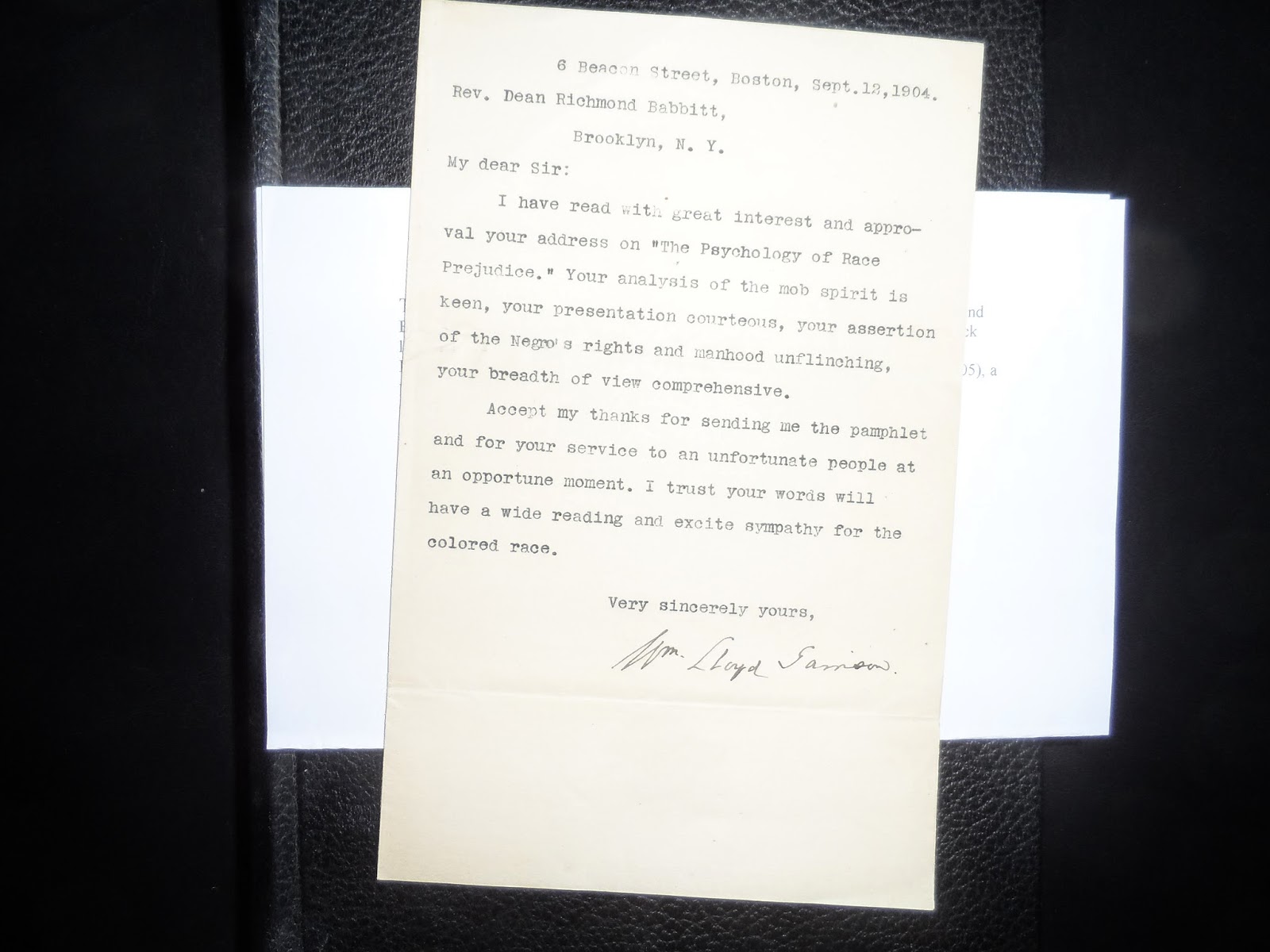
Dean Richmond Babbitt (1850-1905) was a social reform oriented Episcopal minister whose last parish was in Brooklyn. He wrote several articles on lynching and had traveled to Wilmington, Delaware in the wake of the lynching of George White in 1903 to conduct a personal investigation into the surrounding circumstances. That chapter is probably the heart of his unpublished book and my next project. I have made photographs of the typescript available through this blog, but it is rather tedious to download them.
The typescript only recently went on the auction market and it was put there by Dean Richmond Babbitt IV, the author’s great grandson.
Echoes of the lynching phenomenon can be faintly heard in the “stand your ground” controversy, the antics of the Cliven Bundy militia and the recent troubles in Ferguson.
And The Bad News Was
It turns out that the bulk of the essay appeared in a letter to the editor that James wrote to the Springfield Republican. It was widely reported at the time, perhaps because of the thankfully inaccurate prediction that there would soon be negro lynching on the Boston Common. So the consensus of the preeminent William James scholars was that I had only discovered an unknown paragraph or so. You probably noticed the clue but I'll repeat if anyway -
"....I am glad to reassert views I have heretofore uttered on the danger involved in the increasing number and violence of negro lynchings in this country.:
Damn. Did you have to do it word for word, Professor James?
I'm happy to say that even after the bad news Mr. Richardson, who dubbed me independent scholar, is still pleased with my find and offered me this:
Congratulations to Peter Reilly for throwing another log on the anti-racism bonfire. His discovery of a new William James piece throws both light and heat on today. Events in Ferguson MO only shows us that what William James and others were so concerned about is still with us, poisoning our beloved country.